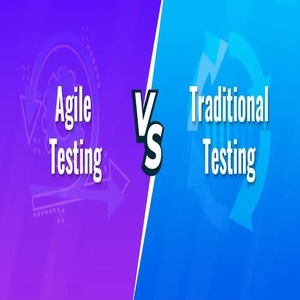
Why Agile Testing Stands Apart from Traditional Approaches
In today’s fast-paced software development landscape, testing is more critical than ever to ensure product quality and customer satisfaction. Over the years, testing has evolved from sequential, isolated processes to integrated, iterative practices. Agile testing represents this shift, offering a stark contrast to traditional methods like the Waterfall model. So, what makes Agile testing fundamentally different?
1. Testing Starts from Day One
Traditional testing typically begins only after development is complete. This delay often results in the late discovery of bugs, higher costs, and project setbacks.
Agile testing, on the other hand, is embedded in every stage of development. Testers work side-by-side with developers from the beginning of the sprint, enabling early defect detection and rapid feedback.
2. Breaking Down Silos
In traditional models, teams often operate in silos—developers write code, then hand it off to testers. This separation can lead to communication gaps and longer feedback loops.
Agile promotes cross-functional collaboration. Developers, testers, product owners, and even customers work together throughout the development cycle. Daily standups, sprint planning sessions, and retrospectives help maintain alignment and speed up decision-making.
3. Embracing Change with Flexible Planning
Traditional test plans are often rigid, making it difficult to accommodate changes in requirements without rework.
Agile thrives on flexibility. Test plans and test cases evolve alongside the product. As user stories and sprint goals shift, testing priorities adapt accordingly, ensuring that the most valuable features are always tested.
4. Automation is Built-In
While test automation exists in traditional approaches, it’s often introduced late or used inconsistently.
In Agile, automation is essential from the start. Continuous integration and delivery (CI/CD) pipelines rely on automated testing at every stage—unit, integration, regression—to maintain code quality and support frequent deployments.
5. Rapid Feedback and Delivery
Traditional methods often delay feedback until the end of the project, which can be months after development began.
Agile emphasizes quick iterations and frequent releases. This allows for faster feedback from stakeholders and end-users, reducing the risk of building features that don’t meet customer needs and enabling continuous improvement.
Conclusion
Agile testing is more than just a process—it’s a shift in mindset. It puts quality at the heart of development, encourages constant collaboration, and embraces change with open arms. While traditional testing served its purpose in slower, linear projects, today’s digital products require the speed, adaptability, and team synergy that Agile testing provides.
You May Also Like
-
Aug 28, 2025
When professionals think of project management tools, names like Jira, Trello, Asana, or Wrike usually come up. However, there’s a...
-
Aug 18, 2025
AI & Automation in Project Management – The Future is Now! The project management landscape is undergoing a massive transformation....

-
Aug 8, 2025
The Hidden Challenge: What to Do When a Critical Project Resource Leaves? Every successful project relies on key contributors—those professionals...

-
Aug 7, 2025
When most people think of project management tools, they imagine platforms like Trello, Asana, or Microsoft Project. However, did you...
Sign up to receive our latest updates
Company
Support
Service Offerings
Special Offers
Get in touch
India
Call us directly?
+91-984-459-1589
Address
Learnerskart Solutions Pvt Ltd
4th floor, No: 207/189, 9th Main Rd, 6th Sector,
HSR Layout, Bengaluru, Karnataka 560102
info@learnerskart.com
USA
Call us directly?
+1 (307)-998-3816
Address
Learnerskart Americas LLC
30 N Gould St Ste R
Sheridan, WY 82801
info@learnerskart.com
Quick Contact
Trending Categories
Disclaimer
“PMI®”, “PMBOK®”, “PMP®”, “CAPM®” and “PMI-ACP®” are registered marks of the Project Management Institute, Inc.
ITIL® and PRINCE2® are registered trade marks of AXELOS Limited, used under permission of AXELOS Limited. All rights reserved.
“CSM”, “CST” are Registered Trade Marks of The Scrum Alliance, USA.
