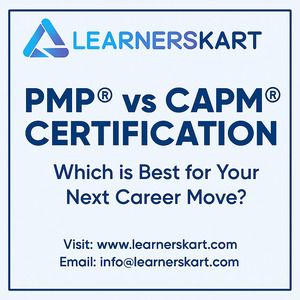
PMP vs CAPM: Which Certification Will Boost Your Career? | Learnerskart
-
September 9, 2025
For every project management professional, one question always arises: Should I pursue PMP® or CAPM®? 🤔 Choosing the right certification can significantly impact your career trajectory, salary, and professional growth. Here’s a quick guide to help you make an informed decision.
🔑 Key Differences Between PMP® and CAPM®
🎓 Eligibility
-
PMP®: Requires 3–5 years of project management experience.
-
CAPM®: No prior experience needed — ideal for beginners entering the field.
🧠 Exam Focus
-
PMP®: Advanced, scenario-driven questions focusing on leadership, strategy, and decision-making.
-
CAPM®: Focuses on fundamentals, project management concepts, and PMBOK® processes.
💼 Career Path
-
PMP®: Project Manager, Program Manager, Senior Leadership roles.
-
CAPM®: Project Coordinator, Junior Project Manager, Analyst roles.
💰 Salary Impact
-
PMP®: Professionals can earn 20–25% higher average salaries globally 🌍.
-
CAPM®: Provides a strong entry-level advantage for career starters 🚀.
📅 Renewal
-
PMP®: Every 3 years with 60 PDUs.
-
CAPM®: Every 3 years by retaking the exam.
✨ Pro Tip
-
Choose CAPM® if you’re entering project management and want foundational knowledge.
-
Choose PMP® if your goal is to lead projects and advance into senior leadership roles.
🎯 Why LearnersKart?
At LearnersKart, we help you master both certifications with:
✅ PMI®-aligned study material
✅ Expert trainers with global experience
✅ Exam-focused preparation including mock tests
✅ Flexible learning designed for busy professionals
📩 Ready to take the next step in your career?
🌐 Visit: www.learnerskart.com
📧 Email: info@learnerskart.com
💡 Your career growth starts with the right choice. Which one will you pursue — PMP® or CAPM®?
Tags:
CAPMCAPM for BeginnersCareer Boostcareer growthExam PreparationGlobal OpportunitiesLeadershipLearnersKartPMBOKPMI CertificationPMPPMP for ProfessionalsPMP vs CAPMprofessional developmentProject Managementproject management certificationProject Management Examproject management skillsProject Management TrainingProject Manager
You May Also Like

-
Feb 16, 2026
If you’re planning to apply for the PMP certification in 2026, one important question comes first: “Am I really eligible...
-
Feb 13, 2026
In today’s fast-paced business environment, choosing the right project delivery approach can determine whether your project succeeds or struggles. Organisations...
-
Feb 10, 2026
In today’s fast-paced and increasingly complex business environment, organisations are no longer managing just one or two initiatives at a...
-
Feb 9, 2026
In project management, confusion over who does what and who makes the final decision is one of the biggest reasons...
Sign up to receive our latest updates
Company
Support
Service Offerings
Special Offers
Get in touch
India
Call us directly?
+91-984-459-1589
Address
Learnerskart Solutions Pvt Ltd
4th floor, No: 207/189, 9th Main Rd, 6th Sector,
HSR Layout, Bengaluru, Karnataka 560102
info@learnerskart.com
USA
Call us directly?
+1 (307)-998-3816
Address
Learnerskart Americas LLC
30 N Gould St Ste R
Sheridan, WY 82801
info@learnerskart.com
Quick Contact
Trending Categories
Disclaimer
“PMI®”, “PMBOK®”, “PMP®”, “CAPM®” and “PMI-ACP®” are registered marks of the Project Management Institute, Inc.
ITIL® and PRINCE2® are registered trade marks of AXELOS Limited, used under permission of AXELOS Limited. All rights reserved.
“CSM”, “CST” are Registered Trade Marks of The Scrum Alliance, USA.
