Agile vs Waterfall Project Management: Which Approach Delivers Better Results?
-
November 13, 2025
Introduction
In today’s fast-paced business environment, choosing the right project management approach can make the difference between success and failure. Two of the most widely used methodologies — Agile and Waterfall — represent fundamentally different ways of planning, executing, and delivering projects.
So, which one delivers better results? The answer depends on your project type, team dynamics, and organizational goals. Let’s explore what these approaches are, why they matter, and how to choose the right one.
What is Waterfall Project Management?
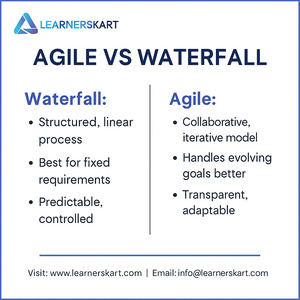
The Waterfall model follows a linear and sequential process. Each phase (requirement gathering, design, development, testing, deployment) must be completed before moving on to the next.
Key Characteristics:
-
Structured and predictable process
-
Ideal for projects with clear, fixed requirements
-
Documentation-heavy approach
-
Limited flexibility for changes
Best Suited For:
-
Construction, manufacturing, and government projects
-
Projects with stable requirements and fixed budgets
-
Teams that value predictability and control
What is Agile Project Management?
Agile is a flexible, iterative approach that emphasizes collaboration, customer feedback, and adaptability. Work is divided into sprints (short development cycles) that deliver value incrementally.
Key Characteristics:
-
Continuous improvement and adaptation
-
Regular stakeholder feedback
-
Faster time-to-market and high customer satisfaction
-
Empowered and self-organized teams
Best Suited For:
-
Software development and dynamic environments
-
Projects with evolving requirements
-
Teams that thrive on innovation and change
Agile vs Waterfall: Key Differences at a Glance
| Feature | Agile | Waterfall |
|---|---|---|
| Approach | Iterative & incremental | Linear & sequential |
| Flexibility | Highly adaptable | Rigid once started |
| Customer Involvement | Continuous feedback | Minimal after the initial phase |
| Documentation | Light, adaptive | Heavy and detailed |
| Delivery | Frequent releases | Single final release |
| Risk Management | Ongoing & adaptive | Managed upfront |
Why It Matters
Choosing the right project management methodology ensures better control over timelines, budgets, and outcomes.
-
Agile helps teams respond quickly to market changes.
-
Waterfall ensures clarity, documentation, and compliance — essential in regulated industries.
How to Choose the Right Approach
Ask yourself:
-
Are project requirements likely to change? → Choose Agile.
-
Is the project scope fixed and well-defined? → Choose Waterfall.
-
Does your team need structure or flexibility?
-
Are stakeholders available for frequent reviews and feedback?
Many modern organizations even use a hybrid approach, combining the structured planning of Waterfall with the flexibility of Agile.
Key Takeaways
-
Agile focuses on adaptability and speed, while Waterfall focuses on stability and structure.
-
No single approach is “better” — the right choice depends on project goals and constraints.
-
Hybrid models are gaining popularity for balancing predictability and agility.
Conclusion
Both Agile and Waterfall have their strengths and limitations. Successful project managers understand when and how to apply each approach — or even blend them.
To truly master these methodologies and advance your project management career, consider earning globally recognized certifications like PMP®, Agile Certified Practitioner (PMI-ACP®), or PRINCE2® with Learnerskart.
About Learnerskart
At Learnerskart.com, we provide industry-recognized certification training and exam assistance to help professionals excel in Project Management, Agile, Lean Six Sigma, and more.
Join 300,000+ professionals who have upskilled with our expert-led online programs.
🌐 Visit: www.learnerskart.com | 📧 Email: info@learnerskart.com
✔️ Follow us for more project management tips & career insights! https://lnkd.in/gYB4Dw4K
Tags:
You May Also Like

-
Feb 16, 2026
If you’re planning to apply for the PMP certification in 2026, one important question comes first: “Am I really eligible...
-
Feb 13, 2026
In today’s fast-paced business environment, choosing the right project delivery approach can determine whether your project succeeds or struggles. Organisations...
-
Feb 10, 2026
In today’s fast-paced and increasingly complex business environment, organisations are no longer managing just one or two initiatives at a...
-
Feb 9, 2026
In project management, confusion over who does what and who makes the final decision is one of the biggest reasons...
Sign up to receive our latest updates
Company
Support
Service Offerings
Special Offers
Get in touch
India
Call us directly?
+91-984-459-1589
Address
Learnerskart Solutions Pvt Ltd
4th floor, No: 207/189, 9th Main Rd, 6th Sector,
HSR Layout, Bengaluru, Karnataka 560102
info@learnerskart.com
USA
Call us directly?
+1 (307)-998-3816
Address
Learnerskart Americas LLC
30 N Gould St Ste R
Sheridan, WY 82801
info@learnerskart.com
Quick Contact
Trending Categories
Disclaimer
“PMI®”, “PMBOK®”, “PMP®”, “CAPM®” and “PMI-ACP®” are registered marks of the Project Management Institute, Inc.
ITIL® and PRINCE2® are registered trade marks of AXELOS Limited, used under permission of AXELOS Limited. All rights reserved.
“CSM”, “CST” are Registered Trade Marks of The Scrum Alliance, USA.
