Project Charter: The Blueprint for Project Success | Learnerskart
-
December 5, 2025
A successful project doesn’t begin with execution — it begins with clarity. And the most powerful tool to achieve that clarity is a Project Charter. Whether you’re launching a new product, building a website, or transforming internal operations, a well-crafted project charter sets the direction, aligns stakeholders, and ensures everyone understands the mission.
In simple terms, a Project Charter is the foundation on which project success is built. It defines what the project is, why it exists, who is involved, and how it will move forward.
What Is a Project Charter?
A Project Charter is a formal document that authorizes the project and gives the project manager the authority to use organizational resources to complete it.
It outlines the purpose, scope, objectives, roles, risks, and overall direction of the project.
It is typically approved by the project sponsor and is often the first official step in a project’s lifecycle.
Why a Project Charter Matters
A strong project charter provides multiple benefits:
✔ Clarity of Purpose
Everyone understands the “why” behind the project.
✔ Scope Definition
It prevents scope creep by clearly outlining what’s included and what’s not.
✔ Stakeholder Alignment
Ensures that sponsors, teams, and customers are aligned from day one.
✔ Authority for the Project Manager
Gives formal approval to lead and allocate resources.
✔ Measurable Success Criteria
Lays down expectations and goals that can be tracked.
Key Components of a Project Charter
A standard project charter includes:
1. Project Title
A clear and concise name.
2. Project Manager & Authority Level
Who is responsible for leading the project and making decisions?
3. Sponsor Information
Who is funding or supporting the initiative?
4. Start & End Dates
Estimated project timeline.
5. Objectives
Specific, measurable, achievable, relevant, and time-bound goals (SMART).
6. Scope
What the project will deliver — and what it will not.
7. Deliverables
Key outputs expected from the project.
8. Budget Estimate
High-level financial expectations.
9. Stakeholders
Groups that will be impacted or involved.
10. Risks & Assumptions
Potential roadblocks and dependencies.
11. Approval Signatures
Formal authorization to begin.
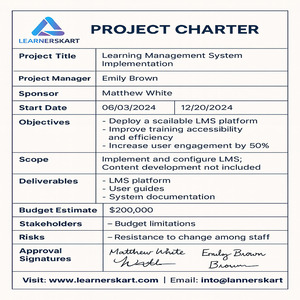
Project Charter Example
Here is a simple, practical example:
Project Title:
New Website Development
Project Manager:
Jane Doe
Sponsor:
John Smith
Start Date – End Date:
05/01/2024 – 10/31/2024
Objectives:
-
Create a modern, user-friendly website
-
Enhance online presence and brand visibility
-
Increase lead generation by 30%
Scope:
Design, develop, and launch a new website
Excludes: Content creation
Deliverables:
-
New website
-
Training materials
-
Maintenance documentation
Budget Estimate:
$150,000
Stakeholders:
Marketing team, Sales team, IT department, Customers
Risks:
Delays in third-party integrations
Approval Signatures:
(Project Sponsor)
(Project Manager)
Best Practices for Creating a Strong Project Charter
-
Keep it clear and concise
-
Avoid overly technical language
-
Use SMART objectives
-
Clearly define scope boundaries
-
Align with organizational goals
-
Review with key stakeholders before approval
Final Thoughts
A well-defined project charter is one of the most valuable tools in project management. It sets expectations, promotes alignment, and serves as a guiding document throughout the project lifecycle. Investing time in creating a strong project charter ensures your project starts with direction, clarity, and confidence.
About LearnersKart
LearnersKart is a trusted platform offering globally recognized professional certification training and exam assistance.
We help working professionals excel in Project Management, Business Analysis, Agile, Lean Six Sigma, ITIL, Digital Marketing, and more.
🌐 Visit: www.learnerskart.com | 📧 Email: info@learnerskart.com
✔️ Follow us for more project management tips & career insights! https://lnkd.in/gYB4Dw4K
Tags:
You May Also Like

-
Feb 16, 2026
If you’re planning to apply for the PMP certification in 2026, one important question comes first: “Am I really eligible...
-
Feb 13, 2026
In today’s fast-paced business environment, choosing the right project delivery approach can determine whether your project succeeds or struggles. Organisations...
-
Feb 10, 2026
In today’s fast-paced and increasingly complex business environment, organisations are no longer managing just one or two initiatives at a...
-
Feb 9, 2026
In project management, confusion over who does what and who makes the final decision is one of the biggest reasons...
Sign up to receive our latest updates
Company
Support
Service Offerings
Special Offers
Get in touch
India
Call us directly?
+91-984-459-1589
Address
Learnerskart Solutions Pvt Ltd
4th floor, No: 207/189, 9th Main Rd, 6th Sector,
HSR Layout, Bengaluru, Karnataka 560102
info@learnerskart.com
USA
Call us directly?
+1 (307)-998-3816
Address
Learnerskart Americas LLC
30 N Gould St Ste R
Sheridan, WY 82801
info@learnerskart.com
Quick Contact
Trending Categories
Disclaimer
“PMI®”, “PMBOK®”, “PMP®”, “CAPM®” and “PMI-ACP®” are registered marks of the Project Management Institute, Inc.
ITIL® and PRINCE2® are registered trade marks of AXELOS Limited, used under permission of AXELOS Limited. All rights reserved.
“CSM”, “CST” are Registered Trade Marks of The Scrum Alliance, USA.
