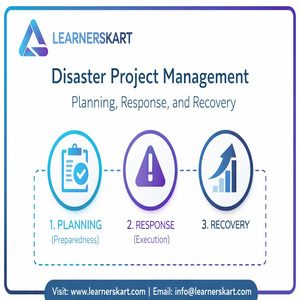
Disaster Project Management: Planning, Response, and Recovery Explained
-
December 17, 2025
In an increasingly unpredictable world, disasters—whether natural, technological, or human-made—can severely disrupt organizations, communities, and economies. From floods and earthquakes to cyberattacks and system outages, the ability to respond quickly and recover effectively has become a critical capability. This is where Disaster Project Management plays a vital role.
Disaster Project Management applies proven project management principles to plan, execute, monitor, and control disaster-related initiatives. For project managers and PMP aspirants, understanding this discipline is not just valuable—it’s essential.
📌 What Is Disaster Project Management?
Disaster Project Management is the structured application of project management knowledge, skills, tools, and techniques to manage projects during and after disasters. These projects may include emergency response initiatives, infrastructure restoration, IT system recovery, healthcare mobilization, or humanitarian relief efforts.
Unlike routine projects, disaster projects operate under:
-
Extreme time pressure
-
High uncertainty and risk
-
Resource constraints
-
Emotional and stakeholder sensitivity
Yet, they still require clear objectives, defined deliverables, schedules, budgets, and accountability—making project management indispensable.
🔄 The Disaster Project Management Lifecycle
Disaster Project Management typically follows three major phases:
1️⃣ Planning (Preparedness Phase)
Planning is the foundation of effective disaster management. Organizations that plan recover faster and minimize losses.
Key Activities in the Planning Phase:
-
Risk Identification & Assessment
Identify potential disaster risks such as natural hazards, cyber threats, supply chain failures, or operational breakdowns. -
Disaster Response Planning
Develop disaster response and business continuity plans outlining roles, responsibilities, escalation paths, and communication protocols. -
Stakeholder & Resource Planning
Identify key stakeholders, emergency teams, vendors, and external agencies. Pre-allocate critical resources where possible. -
Schedule & Cost Baselines
Establish contingency budgets and high-level recovery timelines. -
Training & Simulations
Conduct mock drills and scenario planning to prepare teams for real-life situations.
📘 PMP Connection: Risk Management, Stakeholder Management, Resource Planning, Communications Management
2️⃣ Response (Execution Phase)
The response phase begins immediately after a disaster occurs. Speed, coordination, and leadership are crucial.
Key Activities in the Response Phase:
-
Activate Disaster Plans
Execute predefined disaster response plans and assign responsibilities. -
Rapid Decision-Making
Project managers must make timely decisions with limited information while balancing safety, cost, and schedule. -
Stakeholder Communication
Provide clear, transparent updates to stakeholders, leadership, customers, and teams. -
Resource Mobilization
Deploy emergency teams, procure urgent materials, and coordinate with external partners. -
Monitoring & Control
Track progress, manage risks, control costs, and adjust plans as conditions evolve.
📘 PMP Connection: Executing Process Group, Issue Management, Leadership, Communications
3️⃣ Recovery (Closure & Stabilization Phase)
Recovery focuses on restoring normal operations and building resilience against future disasters.
Key Activities in the Recovery Phase:
-
Restoration of Services
Rebuild infrastructure, restore IT systems, resume operations, and stabilize services. -
Schedule & Cost Recovery
Rebaseline project schedules and budgets based on post-disaster realities. -
Lessons Learned & Documentation
Capture insights, challenges, and best practices to improve future preparedness. -
Process Improvements
Strengthen disaster management frameworks, tools, and organizational readiness. -
Formal Project Closure
Ensure all deliverables are completed, stakeholders are satisfied, and resources are released.
📘 PMP Connection: Closing Process Group, Lessons Learned Register, Continuous Improvement
🧠 Key Skills Required for Disaster Project Managers
To succeed in disaster environments, project managers need more than technical skills.
Essential Skills Include:
-
Strong leadership under pressure
-
Effective communication and stakeholder management
-
Risk and issue management expertise
-
Decision-making in uncertain conditions
-
Emotional intelligence and team empathy
These competencies align closely with the PMI Talent Triangle, making Disaster Project Management highly relevant for PMP certification.
🌍 Real-World Examples of Disaster Project Management
-
COVID-19 Response Projects: Hospital expansion, vaccine distribution, remote work implementation
-
Natural Disaster Recovery: Rebuilding roads, power grids, and housing after floods or earthquakes
-
IT Disaster Recovery: Data center restoration, cybersecurity incident response, system failover projects
Each of these initiatives is temporary, goal-driven, and resource-bound—clearly qualifying as projects.
🎓 Why Disaster Project Management Matters for PMP Aspirants
-
Frequently tested in PMP situational questions
-
Strengthens understanding of risk, leadership, and stakeholder management
-
Demonstrates real-world application of PM principles
-
Enhances career readiness for complex, high-impact roles
✅ Conclusion
Disaster Project Management bridges the gap between chaos and control. By applying structured project management practices to disaster scenarios, organizations can reduce losses, protect stakeholders, and recover faster.
For project managers and PMP aspirants, mastering Disaster Project Management is not just about passing an exam—it’s about becoming a resilient leader capable of delivering results when it matters most.
🚀 Advance Your Project Management Career with Learnerskart
Learnerskart offers industry-recognized PMP, CAPM, and Project Management training designed to help professionals succeed in real-world scenarios—including disaster and crisis management.
🌐 Visit: www.learnerskart.com | 📧 Email: info@learnerskart.com
✔️ Follow us for more project management tips & career insights! https://lnkd.in/gYB4Dw4K
Prepare smarter. Lead stronger. Succeed faster.
Tags:
You May Also Like

-
Feb 17, 2026
When someone says, “I’m a Project Manager,” it sounds straightforward. But the reality is far more complex. A Project Manager...

-
Feb 16, 2026
If you’re planning to apply for the PMP certification in 2026, one important question comes first: “Am I really eligible...
-
Feb 13, 2026
In today’s fast-paced business environment, choosing the right project delivery approach can determine whether your project succeeds or struggles. Organisations...
-
Feb 10, 2026
In today’s fast-paced and increasingly complex business environment, organisations are no longer managing just one or two initiatives at a...
Sign up to receive our latest updates
Company
Support
Service Offerings
Special Offers
Get in touch
India
Call us directly?
+91-984-459-1589
Address
Learnerskart Solutions Pvt Ltd
4th floor, No: 207/189, 9th Main Rd, 6th Sector,
HSR Layout, Bengaluru, Karnataka 560102
info@learnerskart.com
USA
Call us directly?
+1 (307)-998-3816
Address
Learnerskart Americas LLC
30 N Gould St Ste R
Sheridan, WY 82801
info@learnerskart.com
Quick Contact
Trending Categories
Disclaimer
“PMI®”, “PMBOK®”, “PMP®”, “CAPM®” and “PMI-ACP®” are registered marks of the Project Management Institute, Inc.
ITIL® and PRINCE2® are registered trade marks of AXELOS Limited, used under permission of AXELOS Limited. All rights reserved.
“CSM”, “CST” are Registered Trade Marks of The Scrum Alliance, USA.
