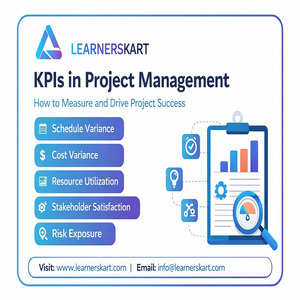
KPIs in Project Management: How to Measure and Drive Project Success
-
December 18, 2025
In today’s competitive and fast-paced business environment, delivering projects on time and within budget is no longer enough. Organisations expect projects to create real business value. This is where Key Performance Indicators (KPIs) play a critical role in project management.
KPIs help project managers measure performance, track progress, identify risks early, and make data-driven decisions. Without KPIs, project success is often based on assumptions rather than facts.
This blog explains what KPIs are, why they matter, and how to use them effectively to drive project success.
What Are KPIs in Project Management?
Key Performance Indicators (KPIs) are measurable values that show how effectively a project is achieving its objectives. In project management, KPIs are used to monitor:
-
Schedule performance
-
Cost efficiency
-
Quality of deliverables
-
Resource utilization
-
Risk exposure
-
Stakeholder satisfaction
KPIs transform project data into actionable insights, enabling project managers to stay in control throughout the project lifecycle.
Why KPIs Are Important for Project Success
KPIs are not just numbers—they are decision-making tools. Effective use of KPIs helps project managers:
-
Track project health in real time
-
Identify delays and cost overruns early
-
Improve accountability and transparency
-
Align project outcomes with business goals
-
Support informed decision-making
-
Increase stakeholder confidence
Projects that actively track KPIs are far more likely to meet their objectives than those that don’t.
KPIs vs Metrics: Understanding the Difference
Although often used interchangeably, KPIs and metrics are not the same.
-
Metrics measure activities or processes (e.g., number of tasks completed).
-
KPIs measure progress toward critical objectives (e.g., schedule variance impacting delivery).
👉 All KPIs are metrics, but not all metrics are KPIs. KPIs focus only on what truly drives success.
Key KPIs in Project Management
Below are the most important KPIs every project manager should track:
1. Schedule Variance (SV)
Measures whether the project is ahead or behind schedule.
Formula:
SV = Earned Value (EV) − Planned Value (PV)
-
SV > 0 → Ahead of schedule
-
SV < 0 → Behind schedule
2. Cost Variance (CV)
Indicates whether the project is under or over budget.
Formula:
CV = Earned Value (EV) − Actual Cost (AC)
-
CV > 0 → Under budget
-
CV < 0 → Over budget
3. Schedule Performance Index (SPI)
Shows schedule efficiency.
Formula:
SPI = EV / PV
-
SPI = 1 → On schedule
-
SPI < 1 → Behind schedule
4. Cost Performance Index (CPI)
Measures cost efficiency.
Formula:
CPI = EV / AC
-
CPI = 1 → On budget
-
CPI < 1 → Over budget
5. Resource Utilisation
Tracks how effectively project resources are being used.
-
Helps avoid over-allocation or underutilization
-
Improves team productivity and morale
6. Quality KPIs
Measure the quality of project deliverables.
Examples:
-
Defect rate
-
Rework percentage
-
Customer acceptance rate
7. Risk KPIs
Monitor the project’s risk exposure.
Examples:
-
Number of open risks
-
Risk severity index
-
Risk response effectiveness
8. Stakeholder Satisfaction
Measures how satisfied stakeholders are with project outcomes.
Examples:
-
Survey scores
-
Feedback ratings
-
Client approval rates
KPIs Across the Project Lifecycle
KPIs should evolve as the project progresses:
-
Initiation: Business value, stakeholder alignment
-
Planning: Schedule feasibility, cost estimates
-
Execution: SPI, CPI, quality metrics
-
Monitoring & Controlling: Variances, risk trends
-
Closing: Customer satisfaction, benefits realization
Common Mistakes When Using KPIs
Avoid these common KPI pitfalls:
-
Tracking too many KPIs
-
Using KPIs that don’t align with project goals
-
Ignoring early warning signals
-
Focusing only on cost and schedule
-
Not communicating KPI results clearly
Effective KPIs are few, relevant, and actionable.
KPIs from a PMP Exam Perspective
For PMP aspirants, KPIs are closely linked to Earned Value Management (EVM) concepts such as:
-
EV, PV, AC
-
CPI and SPI
-
Forecasting techniques
Understanding KPIs is essential not only for real-world project management but also for passing the PMP exam.
Tools to Track Project Management KPIs
Common tools used to monitor KPIs include:
-
Microsoft Excel & Google Sheets
-
Microsoft Project
-
Primavera P6
-
Jira & Agile dashboards
-
Power BI & Tableau
Dashboards make KPIs easier to visualize and interpret.
How KPIs Drive Project Success
When used correctly, KPIs help project managers:
-
Detect issues early
-
Take corrective actions on time
-
Improve performance predictability
-
Deliver projects with confidence
-
Align execution with strategic goals
KPIs turn project management from reactive to proactive.
Conclusion
KPIs in project management are essential for measuring performance and driving project success. They provide clarity, control, and confidence in decision-making.
By selecting the right KPIs and tracking them consistently, project managers can significantly improve project outcomes and stakeholder satisfaction.
Advance Your Project Management Career with Learnerskart
At Learnerskart, we provide industry-leading PMP certification training and exam assistance, helping professionals master core concepts like KPIs, EVM, and project performance management.
🌐 Visit: www.learnerskart.com | 📧 Email: info@learnerskart.com
✔️ Follow us for more project management tips & career insights! https://lnkd.in/gYB4Dw4K
Start your journey toward project management excellence today.
Tags:
You May Also Like

-
Feb 16, 2026
If you’re planning to apply for the PMP certification in 2026, one important question comes first: “Am I really eligible...
-
Feb 13, 2026
In today’s fast-paced business environment, choosing the right project delivery approach can determine whether your project succeeds or struggles. Organisations...

-
Feb 10, 2026
In today’s fast-paced and increasingly complex business environment, organisations are no longer managing just one or two initiatives at a...

-
Feb 9, 2026
In project management, confusion over who does what and who makes the final decision is one of the biggest reasons...
Sign up to receive our latest updates
Company
Support
Service Offerings
Special Offers
Get in touch
India
Call us directly?
+91-984-459-1589
Address
Learnerskart Solutions Pvt Ltd
4th floor, No: 207/189, 9th Main Rd, 6th Sector,
HSR Layout, Bengaluru, Karnataka 560102
info@learnerskart.com
USA
Call us directly?
+1 (307)-998-3816
Address
Learnerskart Americas LLC
30 N Gould St Ste R
Sheridan, WY 82801
info@learnerskart.com
Quick Contact
Trending Categories
Disclaimer
“PMI®”, “PMBOK®”, “PMP®”, “CAPM®” and “PMI-ACP®” are registered marks of the Project Management Institute, Inc.
ITIL® and PRINCE2® are registered trade marks of AXELOS Limited, used under permission of AXELOS Limited. All rights reserved.
“CSM”, “CST” are Registered Trade Marks of The Scrum Alliance, USA.
