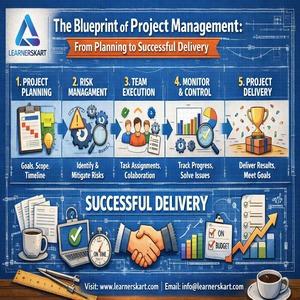
The Blueprint of Project Management: From Planning to Successful Delivery
-
January 13, 2026
In today’s fast-paced business world, projects are the driving force behind growth, innovation, and competitive advantage. Whether you are launching a new product, implementing a software system, or improving business processes, success depends on how well the project is managed. This is where a strong project management blueprint becomes essential.
The Blueprint of Project Management is a structured roadmap that guides a project from idea to completion. It ensures clarity, control, and confidence at every stage.
Let’s explore how this blueprint works — from planning to successful delivery.
1. Initiation – Laying the Foundation
Every successful project starts with a clear purpose. The initiation phase focuses on answering the most important question: Why should this project exist?
At this stage, organizations define the business problem or opportunity, identify stakeholders, and decide whether the project is worth investing in. This prevents wasted effort on projects that do not add real value.
Key activities include:
-
Identifying business needs
-
Defining high-level objectives
-
Recognizing key stakeholders
-
Appointing a project manager
Main output:
The Project Charter, which formally authorizes the project and gives the project manager the authority to proceed.
2. Planning – Creating the Roadmap
Planning is the backbone of project success. A well-planned project is easier to execute, control, and complete on time.
During this phase, the project team defines exactly what will be delivered, how it will be delivered, how long it will take, how much it will cost, and what risks may arise.
Planning covers:
-
Scope definition
-
Schedule development
-
Cost estimation
-
Resource planning
-
Risk management
-
Communication planning
-
Quality planning
-
Stakeholder engagement
Main outputs:
-
Project Management Plan
-
Work Breakdown Structure (WBS)
-
Schedule, Budget, and Risk Register
A strong plan turns ideas into a clear, actionable path forward.
3. Execution – Turning Plans into Results
This is where the real work begins. The execution phase focuses on producing the actual deliverables of the project.
Teams perform tasks, collaborate, solve problems, and build the product or service. The project manager leads the team, manages communication, and ensures everyone stays aligned with the plan.
Key activities include:
-
Completing project tasks
-
Managing the project team
-
Ensuring quality standards
-
Communicating with stakeholders
-
Implementing risk responses
Main outputs:
-
Deliverables
-
Work performance data
-
Change requests
Execution transforms plans into tangible results.
4. Monitoring and Controlling – Keeping the Project on Track
While execution is happening, monitoring and controlling run in parallel. This phase ensures the project stays within scope, schedule, and budget.
Project managers track progress, measure performance, and compare it with the plan. When deviations occur, corrective actions are taken early before problems become serious.
Key activities include:
-
Tracking schedule and cost
-
Managing changes
-
Controlling quality
-
Managing risks and issues
-
Performance reporting
Main outputs:
-
Status reports
-
Performance forecasts
-
Approved change requests
This phase protects the project from failure and keeps it aligned with business goals.
5. Closing – Delivering Success
Closing is more than just finishing work. It ensures the project is formally completed and the results are handed over smoothly.
The team confirms that all deliverables meet expectations, documents lessons learned, releases resources, and archives project records.
Key activities include:
-
Obtaining customer acceptance
-
Handing over deliverables
-
Recording lessons learned
-
Closing contracts
-
Celebrating success
Main outputs:
-
Final project report
-
Lessons learned register
-
Project closure confirmation
A strong closure helps organizations improve future projects and maximize long-term value.
Why This Blueprint Works
This blueprint follows globally accepted PMI (Project Management Institute) best practices. It ensures:
-
Clear direction
-
Controlled execution
-
Reduced risks
-
Predictable results
-
Higher stakeholder satisfaction
It is also the foundation of the PMP® certification framework.
Final Thoughts
Project success is never accidental. It is the result of clear planning, disciplined execution, continuous monitoring, and professional closure.
By following The Blueprint of Project Management, organizations and professionals can deliver projects on time, within budget, and with high quality — every time.
Want to master this blueprint and pass the PMP® exam with confidence?
Get trained by experts at LearnersKart.
🌐 Visit: www.learnerskart.com | 📧 Email: info@learnerskart.com
✔️ Follow us for more project management tips & career insights! https://lnkd.in/gYB4Dw4K
Tags:
blueprint of project managementhow to manage projects successfullyLearnersKart PMP trainingPMI project management modelPMP exam preparationPMP project management frameworkproject delivery frameworkProject Management Best Practicesproject management guideproject management lifecycleproject management process groupsproject planning and execution
You May Also Like

-
Feb 16, 2026
If you’re planning to apply for the PMP certification in 2026, one important question comes first: “Am I really eligible...
-
Feb 13, 2026
In today’s fast-paced business environment, choosing the right project delivery approach can determine whether your project succeeds or struggles. Organisations...
-
Feb 10, 2026
In today’s fast-paced and increasingly complex business environment, organisations are no longer managing just one or two initiatives at a...
-
Feb 9, 2026
In project management, confusion over who does what and who makes the final decision is one of the biggest reasons...
Sign up to receive our latest updates
Company
Support
Service Offerings
Special Offers
Get in touch
India
Call us directly?
+91-984-459-1589
Address
Learnerskart Solutions Pvt Ltd
4th floor, No: 207/189, 9th Main Rd, 6th Sector,
HSR Layout, Bengaluru, Karnataka 560102
info@learnerskart.com
USA
Call us directly?
+1 (307)-998-3816
Address
Learnerskart Americas LLC
30 N Gould St Ste R
Sheridan, WY 82801
info@learnerskart.com
Quick Contact
Trending Categories
Disclaimer
“PMI®”, “PMBOK®”, “PMP®”, “CAPM®” and “PMI-ACP®” are registered marks of the Project Management Institute, Inc.
ITIL® and PRINCE2® are registered trade marks of AXELOS Limited, used under permission of AXELOS Limited. All rights reserved.
“CSM”, “CST” are Registered Trade Marks of The Scrum Alliance, USA.
