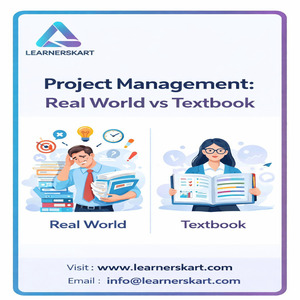
Project Management in the Real World vs the Textbook
-
February 5, 2026
What Professionals Really Need to Succeed
Project management looks perfect in textbooks. Clear processes, defined roles, predictable timelines, and neatly documented plans. But anyone who has managed a real project knows the truth—projects don’t follow textbooks; they test them.
The gap between theoretical project management and real-world execution is where many professionals struggle—and where successful project managers stand apart.
In this blog, we’ll break down the real differences, the practical challenges, and how professionals can master both worlds to deliver consistent project success.
Why This Gap Matters More Than Ever
Organisations today operate in fast-changing environments:
-
Tight deadlines
-
Limited budgets
-
Remote teams
-
Constant scope changes
-
High stakeholder expectations
Yet many professionals rely only on textbook knowledge—leading to delays, conflicts, and project failures.
Understanding the difference between theory and practice isn’t optional anymore. It’s a career-defining skill.
Textbook Project Management: The Ideal World
Textbook project management, guided by frameworks like PMBOK®, PRINCE2®, or Agile guides, provides a structured foundation.
What Textbooks Do Well
-
Clearly defined process groups & knowledge areas
-
Logical sequence of planning → execution → monitoring → closure
-
Standardised tools (WBS, risk registers, stakeholder matrices)
-
Predictable decision-making models
-
Emphasis on documentation and governance
📘 Textbooks teach the “what” and the “why.”
They are essential—but incomplete without real-world application.
Real-World Project Management: The Practical Reality
In reality, projects are dynamic, messy, and influenced by human behavior more than charts.
What Really Happens on Projects
-
Requirements change after approval.
-
Stakeholders disagree or change priorities.
-
Teams multitask across multiple projects.
-
Resources become unavailable suddenly.
-
Risks appear that were never identified.
-
Decisions must be made with incomplete information
💡 Real-world project management is about adaptability, influence, and judgment.
Key Differences: Real World vs Textbook
1. Planning vs Reality
Textbook:
Detailed plans are created upfront and followed step-by-step.
Real World:
Plans change frequently. Good project managers plan continuously, not just once.
✔️ Successful PMs treat plans as living documents.
2. Stakeholder Management
Textbook:
Stakeholders are identified, analysed, and managed logically.
Real World:
Stakeholders have emotions, politics, hidden agendas, and shifting expectations.
✔️ Real success comes from communication, negotiation, and trust-building.
3. Risk Management
Textbook:
Risks are identified, assessed, and tracked in a register.
Real World:
Many risks emerge suddenly and require immediate decisions.
✔️ Experience teaches risk anticipation, not just risk documentation.
4. Scope Management
Textbook:
Change control follows a formal process.
Real World:
“Just a small change” happens frequently—and informally.
✔️ Skilled PMs balance customer satisfaction with scope discipline.
5. Team Management
Textbook:
Teams are aligned, motivated, and focused.
Real World:
Teams face burnout, conflicts, skill gaps, and competing priorities.
✔️ Leadership matters more than authority.
Why Projects Fail Despite Following the Textbook
Many projects fail not because the framework is wrong, but because:
-
Theory is applied rigidly.
-
Human factors are underestimated.
-
Communication is weak
-
Practical decision-making skills are missing
📉 Certification without real-world understanding limits effectiveness.
📈 Experience without structured knowledge limits growth.
Bridging the Gap: Where Successful Project Managers Stand
The most successful professionals:
-
Understand project management frameworks deeply.
-
Adapt them to suit organisational culture.
-
Combine technical knowledge with leadership skills.
-
Make informed decisions under pressure.
-
Learn continuously from every project.
This is where professional certification training plays a critical role.
How Professional Certifications Help Bridge This Gap
Certifications like PMP®, PRINCE2®, ITIL®, and Agile certifications are not just exams—they:
-
Teach best practices tested across industries.
-
Develop structured thinking and decision-making.
-
Improve stakeholder communication
-
Build credibility and confidence.
-
Enable career growth globally.
When combined with real-world examples and practical training, certifications become powerful career accelerators.
What Employers Look for Today
Employers no longer want:
❌ Only theory
❌ Only experience
They want:
✅ Professionals who understand frameworks
✅ Can adapt to real-world challenges
✅ Can lead people, not just processes
✅ Can deliver results under uncertainty
Final Thoughts: Master Both Worlds
Project management is neither purely textbook nor purely instinct—it’s a blend of both.
-
Textbooks provide structure
-
Real projects provide lessons.
-
Successful careers are built by combining both.
If you want to grow as a project manager, don’t choose between theory and practice—master the balance.
Ready to Become a Real-World Project Leader?
Professional certification training with practical guidance helps you:
-
Apply concepts confidently
-
Handle real project challenges.
-
Advance your career faster
🌐 Visit: www.learnerskart.com | 📧 Email: info@learnerskart.com
✔️ Follow us for PM tips & career insights: https://lnkd.in/gYB4Dw4K
Tags:
PMBOK GuidePMP certificationPMP exam preparationPractical Project ManagementProject ManagementProject Management Best PracticesProject Management for Working Professionalsproject management frameworksproject management skillsProject Management TrainingProject Management vs TextbookProject Manager Roles and ResponsibilitiesReal World Project Management
You May Also Like

-
Feb 16, 2026
If you’re planning to apply for the PMP certification in 2026, one important question comes first: “Am I really eligible...
-
Feb 13, 2026
In today’s fast-paced business environment, choosing the right project delivery approach can determine whether your project succeeds or struggles. Organisations...
-
Feb 10, 2026
In today’s fast-paced and increasingly complex business environment, organisations are no longer managing just one or two initiatives at a...
-
Feb 9, 2026
In project management, confusion over who does what and who makes the final decision is one of the biggest reasons...
Sign up to receive our latest updates
Company
Support
Service Offerings
Special Offers
Get in touch
India
Call us directly?
+91-984-459-1589
Address
Learnerskart Solutions Pvt Ltd
4th floor, No: 207/189, 9th Main Rd, 6th Sector,
HSR Layout, Bengaluru, Karnataka 560102
info@learnerskart.com
USA
Call us directly?
+1 (307)-998-3816
Address
Learnerskart Americas LLC
30 N Gould St Ste R
Sheridan, WY 82801
info@learnerskart.com
Quick Contact
Trending Categories
Disclaimer
“PMI®”, “PMBOK®”, “PMP®”, “CAPM®” and “PMI-ACP®” are registered marks of the Project Management Institute, Inc.
ITIL® and PRINCE2® are registered trade marks of AXELOS Limited, used under permission of AXELOS Limited. All rights reserved.
“CSM”, “CST” are Registered Trade Marks of The Scrum Alliance, USA.
