Directing a Project vs Monitoring a Project: Key Differences Explained
-
February 4, 2026
In project management, many professionals use the terms directing a project and monitoring a project interchangeably. However, according to PMI® standards, these are distinct responsibilities that occur throughout the project lifecycle and play very different roles in ensuring project success.
Understanding the difference between directing and monitoring a project is critical for project managers, PMP® aspirants, and team leads—both for real-world execution and PMP exam preparation.
This article explains the concepts clearly, with practical examples and a side-by-side comparison.
What Does It Mean to Direct a Project?
Directing a project refers to leading and managing the actual project work to produce the agreed deliverables. It focuses on execution, decision-making, and coordinating people and resources to move the project forward.
In PMI terminology, this activity aligns closely with Direct and Manage Project Work.
Key Characteristics of Directing a Project
-
Assigning tasks and responsibilities
-
Leading the project team
-
Managing stakeholder expectations
-
Making day-to-day project decisions
-
Ensuring deliverables are produced as planned
-
Implementing approved changes
Directing is action-oriented. The project manager is actively involved in doing the work, solving problems, and keeping momentum.
Example
In a construction project, directing involves instructing site engineers, coordinating vendors, approving work sequences, and ensuring that construction activities follow the approved plan.
What Does It Mean to Monitor a Project?
Monitoring a project focuses on tracking, reviewing, and measuring performance to ensure the project stays aligned with the plan. Instead of executing work, monitoring evaluates how well the work is progressing.
In PMI terms, this aligns with Monitoring and Controlling Project Work.
Key Characteristics of Monitoring a Project
-
Tracking schedule, cost, scope, and quality
-
Measuring performance using KPIs and metrics
-
Identifying variances and risks
-
Reviewing reports and dashboards
-
Recommending corrective or preventive actions
-
Ensuring compliance with baselines
Monitoring is analysis-oriented. The project manager compares planned vs actual performance and decides whether intervention is required.
Example
In an IT project, monitoring includes reviewing sprint velocity, cost burn rate, defect trends, and milestone achievement against the project baseline.
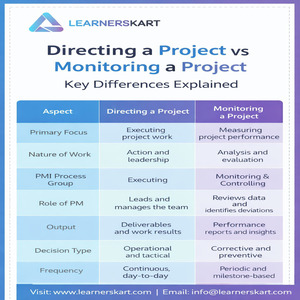
Directing vs Monitoring a Project: Key Differences
| Aspect | Directing a Project | Monitoring a Project |
|---|---|---|
| Primary Focus | Executing project work | Measuring project performance |
| Nature of Work | Action and leadership | Analysis and evaluation |
| PMI Process Group | Executing | Monitoring & Controlling |
| Role of PM | Leads and manages the team | Reviews data and identifies deviations |
| Output | Deliverables and work results | Performance reports and insights |
| Decision Type | Operational and tactical | Corrective and preventive |
| Frequency | Continuous, day-to-day | Periodic and milestone-based |
How Directing and Monitoring Work Together
Directing and monitoring are not sequential activities—they occur in parallel throughout the project.
-
Directing produces work results
-
Monitoring evaluates those results
-
Monitoring identifies issues
-
Directing implements corrective actions
A successful project manager continuously directs based on monitoring insights and monitors the outcomes of directed actions.
Why Understanding This Difference Matters
For Project Managers
-
Improves leadership effectiveness
-
Prevents micromanagement or blind execution
-
Enables proactive decision-making
For PMP® Aspirants
-
Frequently tested concept in PMP exams
-
Strongly linked to Process Groups & EVM
-
Helps answer scenario-based questions accurately
For Organizations
-
Better governance and control
-
Reduced risk of scope creep and cost overruns
-
Improved project predictability
Common Mistakes Project Managers Make
-
Directing without monitoring performance
-
Monitoring issues but delaying action
-
Treating monitoring as reporting only
-
Confusing leadership with control
Avoiding these mistakes requires balancing execution leadership with performance oversight.
Final Thoughts
Directing a project is about making things happen, while monitoring a project is about ensuring the right things are happening.
Both are essential—and when used together effectively, they form the backbone of successful project delivery.
Mastering this distinction not only improves project outcomes but also strengthens your foundation for PMP® certification success.
📌 Want to Master PMP Concepts with Practical Clarity?
Learnerskart offers PMP® certification training with expert guidance, real-world examples, and exam-focused preparation.
🌐 Visit: www.learnerskart.com | 📧 Email: info@learnerskart.com
✔️ Follow us for PM tips & career insights: https://lnkd.in/gYB4Dw4K
Tags:
Direct and Manage Project WorkDirecting vs Monitoring a ProjectMonitoring and Controlling Project WorkPMI Project ManagementPMP certification trainingPMP exam conceptsProject Execution vs Controlproject management process groupsProject Manager Roles and ResponsibilitiesProject Performance Monitoring
You May Also Like
-
Feb 13, 2026
In today’s fast-paced business environment, choosing the right project delivery approach can determine whether your project succeeds or struggles. Organisations...

-
Feb 10, 2026
In today’s fast-paced and increasingly complex business environment, organisations are no longer managing just one or two initiatives at a...

-
Feb 9, 2026
In project management, confusion over who does what and who makes the final decision is one of the biggest reasons...
-
Feb 6, 2026
Many projects fail not because teams lack effort or expertise—but because they confuse project planning with project strategy. While both...
Sign up to receive our latest updates
Company
Support
Service Offerings
Special Offers
Get in touch
India
Call us directly?
+91-984-459-1589
Address
Learnerskart Solutions Pvt Ltd
4th floor, No: 207/189, 9th Main Rd, 6th Sector,
HSR Layout, Bengaluru, Karnataka 560102
info@learnerskart.com
USA
Call us directly?
+1 (307)-998-3816
Address
Learnerskart Americas LLC
30 N Gould St Ste R
Sheridan, WY 82801
info@learnerskart.com
Quick Contact
Trending Categories
Disclaimer
“PMI®”, “PMBOK®”, “PMP®”, “CAPM®” and “PMI-ACP®” are registered marks of the Project Management Institute, Inc.
ITIL® and PRINCE2® are registered trade marks of AXELOS Limited, used under permission of AXELOS Limited. All rights reserved.
“CSM”, “CST” are Registered Trade Marks of The Scrum Alliance, USA.
