Fast Tracking in Project Management | Learnerskart
-
August 14, 2025
Fast Tracking in Project Management – Speed Without Changing Scope
In the fast-paced world of project delivery, deadlines can be tight, expectations high, and budgets fixed. One proven method to meet these challenges without changing the project scope is Fast Tracking.
At LearnersKart, we train PMP® aspirants and project managers to master such schedule compression techniques, ensuring they can deliver results efficiently and confidently.
What is Fast Tracking?
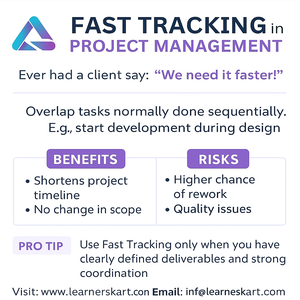
Fast Tracking is a project management schedule compression technique where activities that are normally performed sequentially are carried out in parallel.
Example:
In a construction project, instead of waiting for the entire design phase to finish, parts of the foundation work may begin while the final design details are still being completed.
When Should You Use Fast Tracking?
Fast tracking is best suited when:
-
The project deadline is shortened.
-
The scope remains fixed, but the schedule needs to be compressed.
-
The project team can handle parallel tasks.
Benefits of Fast Tracking
✅ Shorter Delivery Time – Helps meet aggressive deadlines.
✅ No Scope Change – The scope stays intact while the schedule changes.
✅ Competitive Advantage – Faster project completion can mean faster market entry.
Risks of Fast Tracking
⚠️ Higher Risk of Rework – Overlapping activities may require corrections later.
⚠️ Communication Gaps – Multiple teams working in parallel may cause misalignment.
⚠️ Quality Concerns – Increased speed can put pressure on quality control.
Fast Tracking vs. Crashing
While both are schedule compression techniques, they differ:
-
Fast Tracking = Overlapping tasks without adding extra resources.
-
Crashing = Adding resources to speed up completion.
Best Practices for Effective Fast Tracking
-
Strong Planning: Map dependencies before overlapping tasks.
-
Effective Communication: Keep all stakeholders updated in real-time.
-
Risk Management: Identify potential rework areas and prepare mitigation plans.
-
Regular Monitoring: Track progress closely to detect issues early.
Final Thoughts
Fast Tracking is a powerful technique for PMP® aspirants to understand—not just for the exam, but for real-world project management challenges. However, it should be applied with caution and only after analyzing the risks and benefits.
At LearnersKart, our PMP Certification Training equips you with in-depth knowledge of tools like Fast Tracking, Crashing, Critical Path Analysis, and more—helping you excel in both the exam and your career.
Ready to Master PMP Exam Concepts?
📅 Join our upcoming PMP Certification Training batch and learn from industry experts with a first-attempt pass guarantee.
📌 Visit: www.learnerskart.com
📧 Email: info@learnerskart.com
Tags: Fast Tracking in Project Management, PMP Exam Schedule Compression Techniques, Fast Tracking vs Crashing PMP, Project Management Training India, PMP Certification Course LearnersKart, PMP Exam Preparation Tips, Schedule Compression PMP, Project Management Career Growth, PMP Training with Pass Guarantee, LearnersKart PMP Course
Tags:
Fast Tracking in Project ManagementFast Tracking vs Crashing PMPLearnersKart PMP CoursePMP Certification Course LearnersKartPMP Exam Preparation TipsPMP Exam Schedule Compression TechniquesPMP Training with Pass GuaranteeProject Management Career GrowthProject Management Training IndiaSchedule Compression PMP
You May Also Like

-
Feb 16, 2026
If you’re planning to apply for the PMP certification in 2026, one important question comes first: “Am I really eligible...
-
Feb 13, 2026
In today’s fast-paced business environment, choosing the right project delivery approach can determine whether your project succeeds or struggles. Organisations...
-
Feb 10, 2026
In today’s fast-paced and increasingly complex business environment, organisations are no longer managing just one or two initiatives at a...
-
Feb 9, 2026
In project management, confusion over who does what and who makes the final decision is one of the biggest reasons...
Sign up to receive our latest updates
Company
Support
Service Offerings
Special Offers
Get in touch
India
Call us directly?
+91-984-459-1589
Address
Learnerskart Solutions Pvt Ltd
4th floor, No: 207/189, 9th Main Rd, 6th Sector,
HSR Layout, Bengaluru, Karnataka 560102
info@learnerskart.com
USA
Call us directly?
+1 (307)-998-3816
Address
Learnerskart Americas LLC
30 N Gould St Ste R
Sheridan, WY 82801
info@learnerskart.com
Quick Contact
Trending Categories
Disclaimer
“PMI®”, “PMBOK®”, “PMP®”, “CAPM®” and “PMI-ACP®” are registered marks of the Project Management Institute, Inc.
ITIL® and PRINCE2® are registered trade marks of AXELOS Limited, used under permission of AXELOS Limited. All rights reserved.
“CSM”, “CST” are Registered Trade Marks of The Scrum Alliance, USA.
