Gold Plating in Project Management | Learnerskart
-
August 20, 2025
Gold Plating in Project Management: A Hidden Risk You Must Avoid
In project management, success is not about delivering more—it’s about delivering exactly what was agreed in the project scope, with quality and consistency. One common pitfall that project managers and teams fall into is called Gold Plating.
In this article, we’ll explore what gold plating is, why it happens, when it shows up, its advantages and disadvantages, and why professionals should avoid it.
What is Gold Plating?
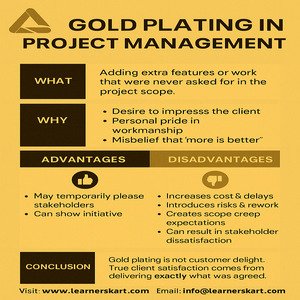
Gold plating in project management refers to adding extra features, functions, or deliverables that were not part of the agreed scope. These additions are often made without client request or approval.
Example:
A software developer decides to add an extra feature to an application that wasn’t in the requirements, thinking it will impress the client.
Why Does Gold Plating Happen?
Gold plating often comes from good intentions, but it creates risks. Common reasons include:
-
Desire to impress the client or manager
-
Personal pride in one’s work
-
Misbelief that “more is better”
-
Lack of clarity in requirements
When Does Gold Plating Occur?
Gold plating usually happens during project execution when:
-
Team members add “extras” without consulting stakeholders
-
Scope is assumed rather than clarified
-
Project managers or teams try to exceed expectations instead of focusing on quality
Advantages (Perceived)
Some believe gold plating offers short-term benefits, such as:
-
Temporarily pleasing stakeholders
-
Showing initiative or creativity
Disadvantages (Real Impact)
The disadvantages, however, outweigh the perceived benefits:
-
Increased costs and delays
-
Higher risks and rework due to untested features
-
Scope creep expectations from stakeholders
-
Stakeholder dissatisfaction if the extra work doesn’t align with their goals
Benefits of Avoiding Gold Plating
Sticking to the defined scope ensures:
-
Controlled project costs and timelines
-
Better predictability in delivery
-
Stronger trust with clients and stakeholders
-
Higher success rates in projects
Final Conclusion
Gold plating is not customer delight. True client satisfaction comes from delivering exactly what was agreed on time, within budget, and with high quality. If new ideas add value, they must undergo a formal change control process, rather than being made through informal additions.
🚀 About LearnersKart
At LearnersKart, we equip project professionals with practical, industry-relevant training that aligns with PMP® standards and best practices. Our programs help you avoid costly mistakes, such as gold plating, and empower you to deliver projects with confidence.
📍 Visit: learnerskart.com
📩 Email: info@learnerskart.com
#ProjectManagement, #PMP, #GoldPlating, #ScopeManagement, #ProjectRisks, #Leadership, #ProjectSuccess, #PMTips, #CustomerDelight, #LearnersKart
Tags:
You May Also Like
-
Apr 3, 2026
Introduction Every year, thousands of professionals begin their journey toward the PMP® certification with high hopes. However, many fail to...
-
Apr 2, 2026
Introduction Why do some projects succeed with detailed planning, while others fail despite having everything mapped out? The answer often...
-
Apr 1, 2026
The PMP Exam Is Changing in Less Than 100 Days – Here’s What You Actually Need to Know If you’ve...

-
Mar 31, 2026
Introduction The role of a Senior Project Manager is evolving faster than ever. With increasing complexity, tighter deadlines, and higher...
Sign up to receive our latest updates
Company
Support
Service Offerings
Special Offers
Get in touch
India
Call us directly?
+91-984-459-1589
Address
Learnerskart Solutions Pvt Ltd
4th floor, No: 207/189, 9th Main Rd, 6th Sector,
HSR Layout, Bengaluru, Karnataka 560102
info@learnerskart.com
USA
Call us directly?
+1 (307)-998-3816
Address
Learnerskart Americas LLC
30 N Gould St Ste R
Sheridan, WY 82801
info@learnerskart.com
Quick Contact
Trending Categories
Disclaimer
“PMI®”, “PMBOK®”, “PMP®”, “CAPM®” and “PMI-ACP®” are registered marks of the Project Management Institute, Inc.
ITIL® and PRINCE2® are registered trade marks of AXELOS Limited, used under permission of AXELOS Limited. All rights reserved.
“CSM”, “CST” are Registered Trade Marks of The Scrum Alliance, USA.
