Leading Projects in 2025: It’s No Longer About Tasks, It’s About Transformation | Learnerskart
-
October 15, 2025
The world of project management is evolving faster than ever. In 2025, successful project leaders are not just managing timelines, budgets, or deliverables — they’re driving transformation that creates lasting impact.
Modern organizations expect more than operational excellence. They need leaders who can inspire change, navigate complexity, and align projects with strategic goals. This is where transformational project leadership becomes the defining skill for the next generation of professionals.
🌍 What Does It Mean to Lead Transformation?
Leading transformation means stepping beyond the traditional role of managing scope and schedule. It’s about influencing people, shaping culture, and delivering value that supports long-term organizational success.
A transformational project leader doesn’t just manage — they motivate, mentor, and mobilize.
Here’s what sets them apart:
-
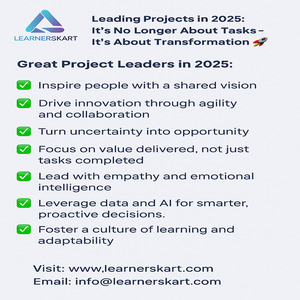
Inspire with vision: Create a shared sense of purpose that unites teams.
-
Drive innovation: Use collaboration and agility to solve complex problems.
-
Navigate uncertainty: Lead with creativity, adaptability, and confidence.
-
Deliver value: Focus on impact, not just output.
-
Lead with empathy: Foster trust, inclusion, and emotional intelligence.
-
Leverage technology: Use AI and data-driven insights to stay ahead.
-
Promote growth: Encourage continuous learning and upskilling within teams.
🚀 How to Lead Transformation in 2025
To thrive as a project leader in the new era, you must combine strategic vision with human-centered leadership and technological fluency.
Here are five key practices to embrace:
1️⃣ Think Big, Act Bold
Every milestone should connect to a meaningful mission. Projects succeed when they contribute to something larger than the checklist of tasks.
2️⃣ Lead with Empathy
People drive projects — not tools or templates. Create a culture where team members feel heard, trusted, and empowered to do their best work.
3️⃣ Leverage Technology
Artificial intelligence, analytics, and automation are reshaping the PM landscape. Smart leaders use these tools to make faster, data-informed decisions and anticipate risks before they escalate.
4️⃣ Empower Your Teams
Great leaders delegate authority, not responsibility. Empower your team to make decisions, take ownership, and innovate without fear of failure.
5️⃣ Embrace Continuous Learning
In a world of constant change, the best project leaders are lifelong learners. Invest in your own growth through certifications, mentorship, and new skill development — and encourage your team to do the same.
🌱 The Benefits of Transformational Leadership
Adopting a transformational approach delivers measurable benefits:
✨ Builds a culture of accountability and innovation
✨ Boosts engagement and team morale
✨ Aligns project outcomes with long-term business goals
✨ Strengthens leadership credibility and personal brand
Transformational leaders don’t just deliver projects — they create impact, inspire growth, and drive meaningful change across organizations.
💭 Final Takeaway
In 2025 and beyond, project management is no longer about managing tasks or timelines.
It’s about leading transformation, delivering value, and shaping the future of how organizations adapt and grow.
At LearnersKart, we help professionals evolve into future-ready, certified project leaders through globally recognized programs like:
-
PMP® (Project Management Professional)
-
PRINCE2® (Projects in Controlled Environments)
-
Lean Six Sigma
Become the kind of leader who doesn’t just deliver — but transforms.
🌐 Visit: www.learnerskart.com | 📧 Email: info@learnerskart.com
✔️ Follow us for more project management tips & career insights! https://lnkd.in/gYB4Dw4K
Tags:
You May Also Like

-
Feb 16, 2026
If you’re planning to apply for the PMP certification in 2026, one important question comes first: “Am I really eligible...
-
Feb 13, 2026
In today’s fast-paced business environment, choosing the right project delivery approach can determine whether your project succeeds or struggles. Organisations...
-
Feb 10, 2026
In today’s fast-paced and increasingly complex business environment, organisations are no longer managing just one or two initiatives at a...
-
Feb 9, 2026
In project management, confusion over who does what and who makes the final decision is one of the biggest reasons...
Sign up to receive our latest updates
Company
Support
Service Offerings
Special Offers
Get in touch
India
Call us directly?
+91-984-459-1589
Address
Learnerskart Solutions Pvt Ltd
4th floor, No: 207/189, 9th Main Rd, 6th Sector,
HSR Layout, Bengaluru, Karnataka 560102
info@learnerskart.com
USA
Call us directly?
+1 (307)-998-3816
Address
Learnerskart Americas LLC
30 N Gould St Ste R
Sheridan, WY 82801
info@learnerskart.com
Quick Contact
Trending Categories
Disclaimer
“PMI®”, “PMBOK®”, “PMP®”, “CAPM®” and “PMI-ACP®” are registered marks of the Project Management Institute, Inc.
ITIL® and PRINCE2® are registered trade marks of AXELOS Limited, used under permission of AXELOS Limited. All rights reserved.
“CSM”, “CST” are Registered Trade Marks of The Scrum Alliance, USA.
