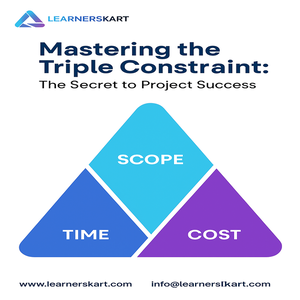
Mastering the Triple Constraint: The Secret to Project Success | Learnerskart
-
August 9, 2025
Mastering the Triple Constraint: The Secret to Project Success
In the world of project management, success rarely happens by accident. It’s the result of strategic planning, effective communication, and above all, balancing the Triple Constraint — also known as the Iron Triangle.
This classic framework focuses on three interdependent factors: Scope, Time, and Cost. Mastering the balance between these three is the key to delivering projects on schedule, within budget, and at the quality expected by stakeholders.
What is the Triple Constraint in Project Management?
The Triple Constraint is a fundamental concept that defines the boundaries and trade-offs of any project:
-
Scope – What the project will deliver (features, functions, and quality of the final product or service).
-
Time – When the project will be delivered (deadlines, schedules, milestones).
-
Cost – How much it will take to deliver the project (budget, resources, materials).
These three elements are interconnected. A change in one inevitably impacts the others. For example:
-
Increasing the scope usually requires more time or higher costs.
-
Reducing time may require more budget or a reduced scope.
-
Cutting costs often means reducing scope or extending deadlines.
Why is the Triple Constraint Important for Project Success?
Balancing scope, time, and cost is critical because it:
-
Clarifies priorities – Helps identify which constraint is most important for a project’s success.
-
Facilitates decision-making – Guides trade-offs in the event of unexpected changes.
-
Improves stakeholder alignment – Keeps expectations realistic and agreed upon.
-
Controls risks – Prevents scope creep, budget overruns, and missed deadlines.
-
Ensures quality – Maintains quality standards within defined limits.
Secrets to Mastering the Triple Constraint
1️⃣ Prioritize the Primary Constraint
Every project has one factor that matters most — whether it’s finishing on time, staying under budget, or delivering full scope. Identify this early.
2️⃣ Manage Changes with Discipline
Use a formal change control process to evaluate how any change in scope, time, or cost will impact the other constraints.
3️⃣ Communicate Trade-offs Clearly
Stakeholders need to understand that improving one area often means making sacrifices in another.
4️⃣ Monitor Progress Constantly
Track timelines, budgets, and scope changes throughout the project lifecycle to prevent surprises.
5️⃣ Keep Quality at the Center
Remember — the goal isn’t just delivering “on time” or “under budget,” but delivering value that meets quality expectations.
Deliverables Meet
Ensures that every project deliverable meets agreed-upon quality standards while staying within the defined scope, schedule, and budget. This balance guarantees stakeholders receive the expected value without compromising the project’s success factors.
Final Thoughts
The Triple Constraint is more than just a project management theory — it’s a practical framework for achieving project success. By mastering the balance between scope, time, and cost, project managers can deliver results that satisfy stakeholders, stay within constraints, and maintain quality.
Whether you’re preparing for your PMP certification, managing complex projects, or leading a small team, understanding and applying the Triple Constraint will set you apart as an effective, results-driven leader.
In project management, success is balancing Scope, Time, and Cost without compromising quality.
📌 Mastering this balance is what separates good project managers from great ones.
🌐 www.learnerskart.com
📩 info@learnerskart.com
Tags: triple constraint in project management, triple constraint examples, scope, time cost project management, iron triangle project management, project management success tips, PMP study material, project management constraints, scope cost time triangle, project management quality control, PMP certification training.
Tags:
You May Also Like

-
Dec 24, 2025
The PMBOK® Guide (Project Management Body of Knowledge) published by the Project Management Institute (PMI®) is the global standard for...
-
Dec 23, 2025
Project management is not a one-size-fits-all discipline. Different projects require different approaches depending on scope, complexity, uncertainty, and stakeholder expectations....
-
Dec 22, 2025
Scope creep is one of the most common reasons projects fail—even when teams are skilled and plans are well prepared....
-
Dec 19, 2025
In today’s fast-changing business environment, delivering value quickly is more important than delivering everything at once. This is where MVP...
Sign up to receive our latest updates
Company
Support
Service Offerings
Special Offers
Get in touch
India
Call us directly?
+91-984-459-1589
Address
Learnerskart Solutions Pvt Ltd
4th floor, No: 207/189, 9th Main Rd, 6th Sector,
HSR Layout, Bengaluru, Karnataka 560102
info@learnerskart.com
USA
Call us directly?
+1 (307)-998-3816
Address
Learnerskart Americas LLC
30 N Gould St Ste R
Sheridan, WY 82801
info@learnerskart.com
Quick Contact
Trending Categories
Disclaimer
“PMI®”, “PMBOK®”, “PMP®”, “CAPM®” and “PMI-ACP®” are registered marks of the Project Management Institute, Inc.
ITIL® and PRINCE2® are registered trade marks of AXELOS Limited, used under permission of AXELOS Limited. All rights reserved.
“CSM”, “CST” are Registered Trade Marks of The Scrum Alliance, USA.
