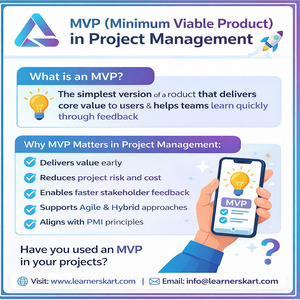
MVP (Minimum Viable Product) in Project Management: A Complete Guide
-
December 19, 2025
In today’s fast-changing business environment, delivering value quickly is more important than delivering everything at once. This is where MVP (Minimum Viable Product) plays a crucial role in modern project management, especially in Agile, Hybrid, and PMP-aligned projects.
This blog explains what MVP is, why it matters, how it is used in project management, and how it is tested in the PMP exam.
What is MVP (Minimum Viable Product)?
A Minimum Viable Product (MVP) is the smallest version of a product that includes only the core features necessary to deliver value to users and collect feedback for future improvements.
The goal of an MVP is learning, not perfection.
Build just enough → Release early → Learn fast → Improve continuously
Why MVP is Important in Project Management
Traditional projects often fail because teams spend too much time building features that users may not even want. MVP helps project managers avoid this risk.
Key Benefits of MVP:
-
Early delivery of business value
-
Reduced cost and development risk
-
Faster stakeholder feedback
-
Better alignment with customer needs
-
Supports adaptive and iterative planning
MVP in Agile, Scrum, and Hybrid Projects
MVP is most commonly used in:
-
Agile projects
-
Scrum frameworks
-
Lean product development
-
Hybrid (Agile + Predictive) approaches
In Agile:
-
MVP is delivered through increments
-
Feedback drives the product backlog
-
Continuous improvement is encouraged
MVP in the PMP Exam Context
PMI emphasizes:
-
Value delivery
-
Customer collaboration
-
Adaptability
MVP strongly supports all these principles.
PMP Exam Tip:
Choose MVP when:
-
Requirements are unclear
-
Stakeholders want early results
-
The project involves innovation or digital products
-
Iterative delivery is preferred over a big-bang release
MVP vs Prototype vs Increment
| Aspect | MVP | Prototype | Increment |
|---|---|---|---|
| Purpose | Validate value | Test concept/design | Add functionality |
| User-facing | Yes | Usually No | Yes |
| Used for feedback | Yes | Limited | Yes |
| PMP relevance | High | Medium | High |
Steps to Build an MVP in Project Management
1. Identify the Problem
Clearly define the business or user problem your project aims to solve.
2. Define Core Requirements
Focus only on must-have features that solve the main problem.
3. Prioritize Features
Use tools like:
-
MoSCoW
-
Product backlog prioritization
-
Value vs effort matrix
4. Develop the MVP
Build the simplest functional version of the product.
5. Release to Users
Deliver the MVP to real users or stakeholders.
6. Collect Feedback
Measure performance using:
-
User feedback
-
KPIs
-
Usage data
7. Improve and Scale
Enhance the product based on real insights, not assumptions.
Real-World Example of MVP
Project: Online Learning Platform
MVP Features:
-
User registration
-
One training course
-
Basic payment option
Future Enhancements:
-
Mobile application
-
Progress analytics
-
AI-based recommendations
-
Certification dashboards
This approach saves time, reduces risk, and ensures market fit.
Common Mistakes to Avoid with MVP
-
Treating MVP as a low-quality product
-
Adding too many features initially
-
Ignoring user feedback
-
Delaying release for perfection
-
Lack of stakeholder communication
When Should You Use MVP?
MVP is ideal when:
-
You are launching a new product
-
Market or requirements are uncertain
-
Innovation is involved
-
Stakeholder feedback is critical
-
Speed-to-market matters
How MVP Improves Project Success
Using MVP helps project managers:
-
Deliver measurable value early
-
Improve stakeholder confidence
-
Reduce rework and waste
-
Increase project success rate
Conclusion
MVP (Minimum Viable Product) is not just a product concept—it is a strategic project management approach that aligns perfectly with Agile principles and PMI’s value-driven mindset.
For project managers and PMP aspirants, understanding MVP is essential for real-world project success and exam readiness.
Advance Your Project Management Career with Learnerskart
Learnerskart provides PMP certification training, Agile learning, and exam-oriented guidance designed for working professionals worldwide.
🔹 PMP Certification Training
🔹 Agile & Hybrid Project Management
🔹 Exam Assistance & Mock Questions
🌐 Visit: www.learnerskart.com | 📧 Email: info@learnerskart.com
✔️ Follow us for more project management tips & career insights! https://lnkd.in/gYB4Dw4K
Tags:
You May Also Like

-
Feb 16, 2026
If you’re planning to apply for the PMP certification in 2026, one important question comes first: “Am I really eligible...
-
Feb 13, 2026
In today’s fast-paced business environment, choosing the right project delivery approach can determine whether your project succeeds or struggles. Organisations...
-
Feb 10, 2026
In today’s fast-paced and increasingly complex business environment, organisations are no longer managing just one or two initiatives at a...
-
Feb 9, 2026
In project management, confusion over who does what and who makes the final decision is one of the biggest reasons...
Sign up to receive our latest updates
Company
Support
Service Offerings
Special Offers
Get in touch
India
Call us directly?
+91-984-459-1589
Address
Learnerskart Solutions Pvt Ltd
4th floor, No: 207/189, 9th Main Rd, 6th Sector,
HSR Layout, Bengaluru, Karnataka 560102
info@learnerskart.com
USA
Call us directly?
+1 (307)-998-3816
Address
Learnerskart Americas LLC
30 N Gould St Ste R
Sheridan, WY 82801
info@learnerskart.com
Quick Contact
Trending Categories
Disclaimer
“PMI®”, “PMBOK®”, “PMP®”, “CAPM®” and “PMI-ACP®” are registered marks of the Project Management Institute, Inc.
ITIL® and PRINCE2® are registered trade marks of AXELOS Limited, used under permission of AXELOS Limited. All rights reserved.
“CSM”, “CST” are Registered Trade Marks of The Scrum Alliance, USA.
