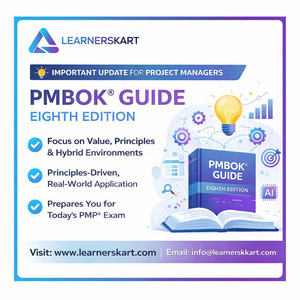
PMBOK® Guide – Eighth Edition: Key Features, Changes, Benefits & PMP® Exam Impact
-
December 24, 2025
The PMBOK® Guide (Project Management Body of Knowledge) published by the Project Management Institute (PMI®) is the global standard for project management best practices. With the release of the PMBOK® Guide – Eighth Edition, PMI has further refined how project managers should think, act, and deliver value in today’s fast-changing business environment.
This blog explains what PMBOK® 8th Edition is, what’s new, key features, why it adds more value, and how it impacts PMP® certification aspirants and professionals.
What Is PMBOK® Guide – Eighth Edition?
The PMBOK® Guide – 8th Edition is the latest evolution of PMI’s flagship standard. It builds on the principles-based approach introduced in the 7th Edition while enhancing practical applicability, clarity, and structure.
Unlike earlier editions that focused heavily on processes and documentation, PMBOK® 8th Edition emphasizes:
-
Value delivery
-
Outcomes over outputs
-
Professional judgment
-
Tailoring based on project context
It supports predictive, agile, and hybrid project environments equally.
Why PMI Released PMBOK® 8th Edition
Modern projects operate in environments defined by:
-
Rapid digital transformation
-
Agile and hybrid delivery models
-
Increased stakeholder expectations
-
Cross-functional and distributed teams
Feedback from professionals after PMBOK® 7 highlighted the need for:
-
More practical guidance
-
Better connection between principles and execution
-
Clearer application in real projects
The 8th Edition addresses these needs while maintaining flexibility.
Core Structure of PMBOK® Guide – 8th Edition
PMBOK® 8th Edition is built on three foundational pillars:
1️⃣ Project Management Principles
These principles guide decision-making and behavior, helping project managers adapt to any environment while maintaining ethical and professional standards.
2️⃣ Performance Domains
Performance Domains describe critical areas of project work that must perform well to achieve successful outcomes. They focus on holistic performance, not isolated activities.
3️⃣ Practical Guidance & Tailoring
PMBOK® 8 improves how guidance is applied by encouraging:
-
Context-driven decisions
-
Flexible sequencing of work
-
Customization based on project needs
This bridges the gap between theory and execution.
🔑 Key Features of PMBOK® Guide – Eighth Edition (High-Value Section)
✔ 1. Value-Driven Project Management
Success is measured by business value and benefits realization, not just scope, schedule, and cost.
✔ 2. Principles Over Rigid Processes
Instead of fixed steps, PMBOK® 8 focuses on how to think and decide, making it applicable to any industry or methodology.
✔ 3. Built for Hybrid Project Environments
PMI formally recognizes that most projects today are hybrid. PMBOK® 8 supports blending predictive and agile practices seamlessly.
✔ 4. Tailoring as a Core Skill
Project managers are encouraged to tailor approaches based on:
-
Risk
-
Complexity
-
Stakeholder needs
-
Organizational maturity
✔ 5. Leadership & People-Centric Focus
Strong emphasis on:
-
Stakeholder engagement
-
Emotional intelligence
-
Team empowerment
-
Ethical leadership
This aligns with PMI’s Talent Triangle®.
✔ 6. Alignment with Digital & Modern Work Practices
The guide acknowledges:
-
Data-driven decision-making
-
Digital collaboration tools
-
Technology-enabled project delivery
Ensuring relevance in today’s workplace.
PMBOK® 7 vs PMBOK® 8: Quick Comparison
| Area | PMBOK® 7th Edition | PMBOK® 8th Edition |
|---|---|---|
| Focus | Conceptual principles | Principles + execution clarity |
| Structure | Highly abstract | More practical & usable |
| Processes | Mostly removed | Better guidance without rigidity |
| Value | Introduced | Strongly reinforced |
| Hybrid Support | Limited clarity | Strong real-world alignment |
Why PMBOK® 8th Edition Adds More Value Than Previous Editions
PMBOK® 8th Edition prepares professionals to:
-
Handle complex, uncertain environments
-
Make better leadership decisions
-
Deliver measurable business outcomes
-
Move beyond checklist-based project management
It transforms project managers from task managers into value leaders.
Impact of PMBOK® 8th Edition on PMP® Certification Exam
🔹 PMP Exam Remains Scenario-Based
The PMP® exam focuses on:
-
Real-world situations
-
Decision-making
-
Leadership and stakeholder management
PMBOK® 8th Edition reinforces this mindset.
🔹 Less Memorization, More Understanding
Candidates must focus on:
-
Why an action is best
-
How value is delivered
-
How to respond in agile and hybrid scenarios
🔹 Alignment with PMP Exam Content Outline (ECO)
PMBOK® 8 concepts align strongly with the three PMP domains:
-
People
-
Process
-
Business Environment
Who Should Read PMBOK® Guide – 8th Edition?
This edition is ideal for:
-
PMP® aspirants
-
Working project managers
-
Agile & hybrid practitioners
-
Program and portfolio managers
-
Professionals moving into leadership roles
Applicable across IT, construction, healthcare, finance, manufacturing, and services.
Frequently Asked Questions (FAQ)
Q1. Is PMBOK® 8th Edition mandatory for the PMP® exam?
The PMP exam follows the ECO, not a single book. PMBOK® 8 supports the mindset tested in the exam.
Q2. Does PMBOK® 8 replace Agile frameworks?
No. It complements Agile, Scrum, and hybrid frameworks.
Q3. Can beginners understand PMBOK® 8?
Yes, especially when supported by structured training and real-world examples.
Final Thoughts
The PMBOK® Guide – Eighth Edition is not just an update—it reflects how modern project management actually works. It combines:
-
Principles
-
Performance
-
Practical flexibility
For PMP® aspirants and professionals, mastering PMBOK® 8 concepts means better exam performance, stronger leadership skills, and long-term career growth.
🎓 Prepare for PMP® with the Latest PMI Standards
Get expert-led PMP® Certification Training & Exam Assistance aligned with the latest PMI guidance.
🌐 Visit: www.learnerskart.com | 📧 Email: info@learnerskart.com
✔️ Follow us for more project management tips & career insights! https://lnkd.in/gYB4Dw4K
Tags:
You May Also Like

-
Feb 16, 2026
If you’re planning to apply for the PMP certification in 2026, one important question comes first: “Am I really eligible...
-
Feb 13, 2026
In today’s fast-paced business environment, choosing the right project delivery approach can determine whether your project succeeds or struggles. Organisations...
-
Feb 10, 2026
In today’s fast-paced and increasingly complex business environment, organisations are no longer managing just one or two initiatives at a...
-
Feb 9, 2026
In project management, confusion over who does what and who makes the final decision is one of the biggest reasons...
Sign up to receive our latest updates
Company
Support
Service Offerings
Special Offers
Get in touch
India
Call us directly?
+91-984-459-1589
Address
Learnerskart Solutions Pvt Ltd
4th floor, No: 207/189, 9th Main Rd, 6th Sector,
HSR Layout, Bengaluru, Karnataka 560102
info@learnerskart.com
USA
Call us directly?
+1 (307)-998-3816
Address
Learnerskart Americas LLC
30 N Gould St Ste R
Sheridan, WY 82801
info@learnerskart.com
Quick Contact
Trending Categories
Disclaimer
“PMI®”, “PMBOK®”, “PMP®”, “CAPM®” and “PMI-ACP®” are registered marks of the Project Management Institute, Inc.
ITIL® and PRINCE2® are registered trade marks of AXELOS Limited, used under permission of AXELOS Limited. All rights reserved.
“CSM”, “CST” are Registered Trade Marks of The Scrum Alliance, USA.
