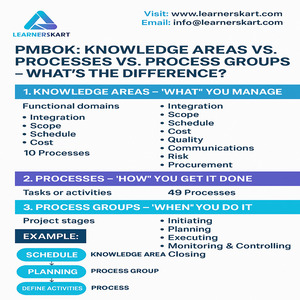
🎓 PMBOK: Knowledge Areas vs. Process Groups vs. Processes – What’s the Difference? | Learnerskart
Understand the 49 PMBOK® processes (7th Edition)—grouped into 5 Process Groups and 10 Knowledge Areas. Essential for PMP® prep and project success!
🎯 The 10 Knowledge Areas:
1) Integration Management
2) Scope Management
3) Schedule Management
4) Cost Management
5) Quality Management
6) Resource Management
7) Communication Management
8) Risk Management
9) Procurement Management
10) Stakeholder Management
🎯 The 5 Process Groups:
1) Initiating
2) Planning
3) Executing
4) Monitoring & Controlling
5) Closing
🎯 The 49 Project Management Processes (with Numbers)
🌟 [1] Initiating (2 processes)
1) Develop Project Charter (Integration)
2) Identify Stakeholders (Stakeholder)
🌟 [2] Planning (24 processes)
3) Develop Project Management Plan (Integration)
4) Plan Scope Management (Scope)
5) Collect Requirements (Scope)
6) Define Scope (Scope)
7) Create WBS (Scope)
8) Plan Schedule Management (Schedule)
9) Define Activities (Schedule)
10) Sequence Activities (Schedule)
11) Estimate Activity Durations (Schedule)
12) Develop Schedule (Schedule)
13) Plan Cost Management (Cost)
14) Estimate Costs (Cost)
15) Determine Budget (Cost)
16) Plan Quality Management (Quality)
17) Plan Resource Management (Resources)
18) Estimate Activity Resources (Resources)
19) Plan Communications Management (Communications)
20) Plan Risk Management (Risk)
21) Identify Risks (Risk)
22) Perform Qualitative Risk Analysis (Risk)
23) Perform Quantitative Risk Analysis (Risk)
24) Plan Risk Responses (Risk)
25) Plan Procurement Management (Procurement)
26) Plan Stakeholder Engagement (Stakeholder)
🌟 [3] Executing (10 processes)
27) Direct and Manage Project Work (Integration)
28) Manage Project Knowledge (Integration)
29) Manage Quality (Quality)
30) Acquire Resources (Resources)
31) Develop Team (Resources)
32) Manage Team (Resources)
33) Manage Communications (Communications)
34) Implement Risk Responses (Risk)
35) Conduct Procurements (Procurement)
36) Manage Stakeholder Engagement (Stakeholder)
🌟 [4] Monitoring & Controlling (12 processes)
37) Monitor and Control Project Work (Integration)
38) Perform Integrated Change Control (Integration)
39) Validate Scope (Scope)
40) Control Scope (Scope)
41) Control Schedule (Schedule)
42) Control Costs (Cost)
43) Control Quality (Quality)
44) Control Resources (Resources)
45) Monitor Communications (Communications)
46) Monitor Risks (Risk)
47) Control Procurements (Procurement)
48) Monitor Stakeholder Engagement (Stakeholder)
🌟 [5] Closing (1 process)
49) Close Project or Phase (Integration)
📌 Conclusion
These 49 processes form the backbone of modern project management. Whether you’re preparing for the PMP® exam or managing real-world projects, mastering them will elevate your project success rate.
📞 Need PMP Training or Coaching?
✅ Visit: www.learnerskart.com
📧 Email: info@learnerskart.com
#ProjectManagement #PMP #PMBOK #PMPExam #ProjectManager #49Processes #ProcessGroups #KnowledgeAreas #PMPTraining #ProjectLeadership #ProfessionalDevelopment #ManagementSkills #PMI #ProjectPlanning #LearnersKart
Tags:
You May Also Like
-
Aug 28, 2025
When professionals think of project management tools, names like Jira, Trello, Asana, or Wrike usually come up. However, there’s a...
-
Aug 18, 2025
AI & Automation in Project Management – The Future is Now! The project management landscape is undergoing a massive transformation....

-
Aug 8, 2025
The Hidden Challenge: What to Do When a Critical Project Resource Leaves? Every successful project relies on key contributors—those professionals...

-
Aug 7, 2025
When most people think of project management tools, they imagine platforms like Trello, Asana, or Microsoft Project. However, did you...
Sign up to receive our latest updates
Company
Support
Service Offerings
Special Offers
Get in touch
India
Call us directly?
+91-984-459-1589
Address
Learnerskart Solutions Pvt Ltd
4th floor, No: 207/189, 9th Main Rd, 6th Sector,
HSR Layout, Bengaluru, Karnataka 560102
info@learnerskart.com
USA
Call us directly?
+1 (307)-998-3816
Address
Learnerskart Americas LLC
30 N Gould St Ste R
Sheridan, WY 82801
info@learnerskart.com
Quick Contact
Trending Categories
Disclaimer
“PMI®”, “PMBOK®”, “PMP®”, “CAPM®” and “PMI-ACP®” are registered marks of the Project Management Institute, Inc.
ITIL® and PRINCE2® are registered trade marks of AXELOS Limited, used under permission of AXELOS Limited. All rights reserved.
“CSM”, “CST” are Registered Trade Marks of The Scrum Alliance, USA.
