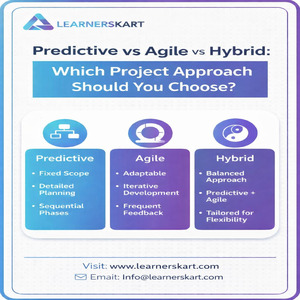
Predictive vs Agile vs Hybrid: How to Choose the Right Approach for Your Project
-
February 13, 2026
In today’s fast-paced business environment, choosing the right project delivery approach can determine whether your project succeeds or struggles. Organisations often face a critical decision: Should we use Predictive, Agile, or Hybrid?
Each approach has its strengths, and the best choice depends on your project’s complexity, requirements, stakeholders, and business goals.
In this blog, we break down each approach and help you decide which one fits your project best.
1. Predictive (Waterfall) Approach
The Predictive approach, often called Waterfall, follows a structured, sequential process. Everything is planned upfront before execution begins.
Key Characteristics:
-
Clearly defined scope at the start
-
Detailed documentation and planning
-
Sequential project phases
-
Strict change control processes
Best Suited For:
-
Construction and infrastructure projects
-
Manufacturing
-
Government projects
-
Projects with fixed budgets and strict regulations
-
When requirements are stable and unlikely to change
Advantages:
-
Clear roadmap and timelines
-
Easier budget estimation
-
Strong documentation and compliance
-
Predictable outcomes when scope is stable
Limitations:
-
Difficult to accommodate changes
-
Late discovery of issues
-
Less flexibility
If your project requires certainty, compliance, and detailed upfront planning, Predictive may be the right choice.
2. Agile Approach
Agile is an adaptive and iterative approach focused on delivering value in small increments. It embraces change and continuous feedback.
Key Characteristics:
-
Iterative development (Sprints)
-
Continuous stakeholder involvement
-
Flexible scope
-
Fast feedback cycles
Best Suited For:
-
Software development
-
Product innovation
-
Startups
-
Projects with evolving requirements
-
Dynamic business environments
Advantages:
-
High flexibility
-
Faster delivery of usable outcomes
-
Continuous improvement
-
Strong collaboration
Limitations:
-
Less predictability in cost and timeline
-
Requires active stakeholder involvement
-
May struggle in highly regulated industries
If your project needs speed, adaptability, and innovation, Agile is often the best fit.
3. Hybrid Approach
Hybrid combines elements of both Predictive and Agile. It offers structure where needed and flexibility where beneficial.
Key Characteristics:
-
High-level planning upfront
-
Agile execution for development phases
-
Balanced governance and adaptability
-
Tailored methodology
Best Suited For:
-
Large organizations undergoing digital transformation
-
Enterprise IT implementations
-
Complex projects with both fixed and evolving components
-
Organizations transitioning from traditional to Agile methods
Advantages:
-
Balanced control and flexibility
-
Better risk management
-
Practical for real-world business scenarios
-
Customizable to organizational needs
Limitations:
-
Requires strong project management skills
-
Needs clarity on which parts use which approach
-
Can become complex without proper governance
Hybrid is often the most practical choice for modern enterprises.
How to Choose the Right Approach?
Here are five key questions to guide your decision:
1. Are Requirements Stable?
-
Yes → Predictive
-
No → Agile
-
Partially → Hybrid
2. Is Stakeholder Feedback Frequent?
-
Limited → Predictive
-
Continuous → Agile
-
Mixed → Hybrid
3. Is Regulatory Compliance Critical?
-
Yes → Predictive or Hybrid
-
No → Agile
4. Is Time-to-Market a Priority?
-
Yes → Agile
-
Moderate → Hybrid
-
Not urgent → Predictive
5. What Is Your Organizational Culture?
-
Process-driven → Predictive
-
Collaborative and flexible → Agile
-
Transitioning → Hybrid
Final Thoughts
There is no “one-size-fits-all” solution in project management. The right approach depends on your project environment, risk tolerance, business objectives, and team maturity.
-
Predictive offers structure and certainty.
-
Agile provides flexibility and speed.
-
Hybrid delivers balance and customization.
Successful organizations understand that selecting the right methodology is a strategic decision—not just a procedural one.
Need Expert Guidance?
Choosing the right project delivery approach requires knowledge, practical experience, and strategic understanding.
If you want to enhance your project management skills or train your team in Predictive, Agile, or Hybrid methodologies, connect with us:
Learnerskart
🌐 Visit: www.learnerskart.com | 📧 Email: info@learnerskart.com
✔️ Follow us for PM tips & career insights: https://lnkd.in/gYB4Dw4K
Tags:
Agile MethodologyAgile vs PredictiveDigital transformation projectsEnterprise Project ManagementHybrid methodologyHybrid Project ManagementPMI Project Managementpmp conceptsPredictive project managementProject delivery approachProject management methodologyProject planning strategiesWaterfall vs Agile
You May Also Like
-
Feb 10, 2026
In today’s fast-paced and increasingly complex business environment, organisations are no longer managing just one or two initiatives at a...
-
Feb 9, 2026
In project management, confusion over who does what and who makes the final decision is one of the biggest reasons...
-
Feb 6, 2026
Many projects fail not because teams lack effort or expertise—but because they confuse project planning with project strategy. While both...

-
Feb 5, 2026
What Professionals Really Need to Succeed Project management looks perfect in textbooks. Clear processes, defined roles, predictable timelines, and neatly...
Sign up to receive our latest updates
Company
Support
Service Offerings
Special Offers
Get in touch
India
Call us directly?
+91-984-459-1589
Address
Learnerskart Solutions Pvt Ltd
4th floor, No: 207/189, 9th Main Rd, 6th Sector,
HSR Layout, Bengaluru, Karnataka 560102
info@learnerskart.com
USA
Call us directly?
+1 (307)-998-3816
Address
Learnerskart Americas LLC
30 N Gould St Ste R
Sheridan, WY 82801
info@learnerskart.com
Quick Contact
Trending Categories
Disclaimer
“PMI®”, “PMBOK®”, “PMP®”, “CAPM®” and “PMI-ACP®” are registered marks of the Project Management Institute, Inc.
ITIL® and PRINCE2® are registered trade marks of AXELOS Limited, used under permission of AXELOS Limited. All rights reserved.
“CSM”, “CST” are Registered Trade Marks of The Scrum Alliance, USA.
