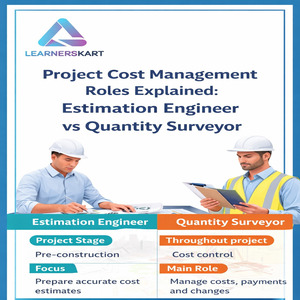
Project Cost Management Roles Explained: Estimation Engineer vs Quantity Surveyor
-
February 3, 2026
In every successful construction project, one factor quietly decides profit or loss — how well costs are planned, tracked, and controlled. Behind this responsibility are two critical professionals: the Estimation Engineer and the Quantity Surveyor (QS).
Although both work with numbers and costs, their roles are not interchangeable. Each contributes to project cost management at different stages, with different objectives. Understanding this distinction is essential for project owners, construction firms, and professionals planning their careers.
What Is Project Cost Management?
Project cost management is more than just calculating numbers. It ensures that a project is completed within the approved budget while delivering maximum value. It includes:
- Estimating project costs
- Setting realistic budgets
- Monitoring actual expenses
- Managing variations and claims
- Forecasting final project cost
- Controlling financial risks
These activities span the entire project lifecycle, which is why both Estimation Engineers and Quantity Surveyors play vital—but different—roles.
Role of an Estimation Engineer in Project Cost Management
Focus Area: Pre-Construction & Tender Stage
An Estimation Engineer comes into action before the first brick is laid. Their primary responsibility is to predict the probable cost of a project as accurately as possible.
At this stage, decisions made by the estimator directly impact whether a company wins a project—and whether it remains profitable.
Key Responsibilities
- Studying drawings, specifications, and scope documents
- Preparing detailed cost estimates and Bills of Quantities (BOQs)
- Calculating material, labor, equipment, overhead, and indirect costs
- Preparing tender pricing and bid submissions
- Comparing vendor and subcontractor quotations
- Identifying cost risks during bidding
Value to the Project
- Establishes the initial cost baseline
- Supports competitive and realistic bidding
- Helps management make informed go/no-go decisions
In simple terms, Estimation Engineers answer the question: “How much will this project cost if we execute it?”
Role of a Quantity Surveyor in Project Cost Management
Focus Area: From Project Start to Completion
A Quantity Surveyor (QS) takes responsibility once the project moves beyond estimation. Their role is to control, monitor, and protect project finances throughout execution.
Unlike estimators, QS professionals remain involved from pre-construction planning all the way to final account closure.
Key Responsibilities
- Preparing cost plans and project budgets
- Managing procurement and contract administration
- Tracking actual costs against planned budgets
- Handling variations, claims, and change orders
- Certifying interim payments and final bills
- Advising stakeholders on cost-saving measures and value engineering
Value to the Project
- Prevents budget overruns
- Reduces contractual disputes
- Ensures financial transparency and accountability
In practical terms, Quantity Surveyors answer the question: “Are we spending what we planned—and how can we control it better?”
Estimation Engineer vs Quantity Surveyor: Key Differences
| Aspect | Estimation Engineer | Quantity Surveyor |
|---|---|---|
| Primary Stage | Pre-construction | Entire project lifecycle |
| Core Responsibility | Cost estimation & bidding | Cost control & contract management |
| Commercial Exposure | Limited | High |
| Client Interaction | Minimal | Extensive |
| Contract Knowledge | Basic | Advanced |
| Risk Handling | Identifies bid-stage risks | Manages variations and claims |
How Both Roles Work Together
Successful project cost management depends on collaboration between estimators and quantity surveyors.
- The estimate prepared by the Estimation Engineer becomes the budget reference
- The Quantity Surveyor uses this baseline to monitor costs and control deviations
- Together, they ensure financial discipline from planning to project close-out
When these roles work in isolation, projects often suffer from cost overruns or disputes. When they work together, projects stay profitable and predictable.
Career Perspective: Which Role Should You Choose?
Choose Estimation Engineering if you:
- Enjoy analytical, office-based work
- Prefer working with drawings, numbers, and pricing
- Like early-stage project planning and bidding
Choose Quantity Surveying if you:
- Enjoy commercial management and negotiations
- Want involvement throughout the project lifecycle
- Aspire to senior roles such as Commercial Manager or Contracts Manager
Final Thoughts
Both Estimation Engineers and Quantity Surveyors are essential to effective project cost management, but their responsibilities serve different purposes.
- Estimation Engineers focus on predicting and planning costs before execution
- Quantity Surveyors focus on controlling and optimizing costs during execution
Understanding these roles helps organizations deliver projects efficiently and helps professionals build clear, future-ready careers in construction and project management.
Want to strengthen your project cost management and project management skills?
Learnerskart offers industry-focused professional training programs designed to help engineers and project professionals grow with confidence.
🌐 Visit: www.learnerskart.com | 📧 Email: info@learnerskart.com
✔️ Follow us for PM tips & career insights: https://lnkd.in/gYB4Dw4K
Tags:
You May Also Like

-
Feb 13, 2026
In today’s fast-paced business environment, choosing the right project delivery approach can determine whether your project succeeds or struggles. Organisations...

-
Feb 10, 2026
In today’s fast-paced and increasingly complex business environment, organisations are no longer managing just one or two initiatives at a...
-
Feb 9, 2026
In project management, confusion over who does what and who makes the final decision is one of the biggest reasons...
-
Feb 6, 2026
Many projects fail not because teams lack effort or expertise—but because they confuse project planning with project strategy. While both...
Sign up to receive our latest updates
Company
Support
Service Offerings
Special Offers
Get in touch
India
Call us directly?
+91-984-459-1589
Address
Learnerskart Solutions Pvt Ltd
4th floor, No: 207/189, 9th Main Rd, 6th Sector,
HSR Layout, Bengaluru, Karnataka 560102
info@learnerskart.com
USA
Call us directly?
+1 (307)-998-3816
Address
Learnerskart Americas LLC
30 N Gould St Ste R
Sheridan, WY 82801
info@learnerskart.com
Quick Contact
Trending Categories
Disclaimer
“PMI®”, “PMBOK®”, “PMP®”, “CAPM®” and “PMI-ACP®” are registered marks of the Project Management Institute, Inc.
ITIL® and PRINCE2® are registered trade marks of AXELOS Limited, used under permission of AXELOS Limited. All rights reserved.
“CSM”, “CST” are Registered Trade Marks of The Scrum Alliance, USA.
