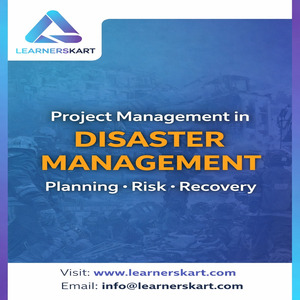
Project Management in Disaster Management: Planning, Risk, and Recovery
-
January 6, 2026
Disasters—whether natural or man-made—create highly complex, time-critical, and uncertain situations. Earthquakes, floods, pandemics, industrial accidents, and climate-related emergencies demand swift decisions, coordinated action, and effective use of limited resources. In such environments, traditional ad-hoc responses are no longer sufficient.
This is where project management plays a vital role in disaster management. By applying structured planning, risk management, execution control, and recovery frameworks, disaster response efforts can move from chaos to coordination—ultimately saving lives and accelerating recovery.
Disaster Management as a Project
Disaster management can be viewed as a high-impact, temporary project with clearly defined objectives:
-
Protect human life
-
Minimize damage to property and infrastructure
-
Ensure efficient emergency response
-
Restore normalcy as quickly as possible
Like any project, disaster management involves:
-
Multiple stakeholders
-
Limited budgets and resources
-
Tight timelines
-
High uncertainty and risk
-
Critical deliverables
Using project management methodologies provides discipline, accountability, and clarity during emergencies.
Importance of Planning in Disaster Management
Planning is the foundation of effective disaster management. Without advance planning, emergency responses become reactive, delayed, and inefficient.
Key Planning Elements
-
Hazard identification and preparedness planning
-
Scope definition for response and recovery activities
-
Resource planning for personnel, equipment, medical aid, and funds
-
Communication planning across agencies and stakeholders
-
Scheduling and prioritisation of rescue and relief tasks
Project management tools such as Work Breakdown Structure (WBS), responsibility assignment matrices (RACI), and timelines help create robust disaster preparedness plans that can be activated immediately when disaster strikes.
Risk Management: The Core of Disaster Projects
Risk management is the heart of disaster management. Unlike traditional projects, disaster projects face dynamic and evolving risks that directly impact human lives.
Risk Management in Disaster Management Includes:
-
Risk Identification – natural hazards, infrastructure collapse, supply chain disruptions, communication failures
-
Risk Analysis – assessing probability, severity, and potential impact
-
Risk Response Planning – mitigation strategies, contingency reserves, emergency protocols
-
Continuous Monitoring – updating risks as conditions change
Effective risk management enables proactive decision-making, reduces response delays, and prevents secondary disasters.
Execution and Coordination During Disaster Response
During the response phase, coordination is critical. Multiple stakeholders—government agencies, emergency services, NGOs, volunteers, healthcare providers, and local authorities—must work together seamlessly.
How Project Management Helps:
-
Clear leadership roles and responsibilities
-
Real-time tracking of tasks and resources
-
Change control to adapt to evolving conditions
-
Structured communication and reporting
Strong execution prevents duplication of efforts, minimizes confusion, and ensures help reaches affected communities faster.
Disaster Recovery as a Long-Term Project
Recovery is not a short-term activity—it is a long-term project focused on rebuilding and strengthening resilience.
Key Recovery Activities:
-
Damage and needs assessment
-
Infrastructure reconstruction
-
Economic and social rehabilitation
-
Monitoring progress and controlling costs
-
Capturing lessons learned for future preparedness
Project management ensures recovery initiatives are transparent, accountable, sustainable, and outcome-focused.
Applying PMBOK Knowledge Areas to Disaster Management
Project management frameworks align naturally with disaster management needs:
-
Integration Management – coordinating diverse response activities
-
Scope Management – defining clear boundaries for response and recovery
-
Schedule & Cost Management – managing urgency and budget constraints
-
Quality Management – ensuring safety and reliability of relief efforts
-
Risk Management – anticipating and managing uncertainties
-
Stakeholder & Communication Management – managing expectations and information flow
This alignment highlights why trained project managers are increasingly essential in disaster management initiatives worldwide.
Conclusion
Disaster management is no longer just an emergency function—it is a complex project environment that requires structured planning, proactive risk management, disciplined execution, and organized recovery.
By integrating project management principles into disaster management, organizations can respond faster, coordinate better, minimize losses, and rebuild stronger communities.
In a world facing rising climate risks and large-scale emergencies, project management is not optional—it is essential.
📞 Learnerskart – Contact Details
🌐 Visit: www.learnerskart.com | 📧 Email: info@learnerskart.com
✔️ Follow us for more project management tips & career insights! https://lnkd.in/gYB4Dw4K
Learnerskart provides professional certification training and career-focused learning programs, helping aspiring and working professionals build real-world project management expertise.
Tags:
You May Also Like
-
Feb 13, 2026
In today’s fast-paced business environment, choosing the right project delivery approach can determine whether your project succeeds or struggles. Organisations...

-
Feb 10, 2026
In today’s fast-paced and increasingly complex business environment, organisations are no longer managing just one or two initiatives at a...
-
Feb 9, 2026
In project management, confusion over who does what and who makes the final decision is one of the biggest reasons...
-
Feb 6, 2026
Many projects fail not because teams lack effort or expertise—but because they confuse project planning with project strategy. While both...
Sign up to receive our latest updates
Company
Support
Service Offerings
Special Offers
Get in touch
India
Call us directly?
+91-984-459-1589
Address
Learnerskart Solutions Pvt Ltd
4th floor, No: 207/189, 9th Main Rd, 6th Sector,
HSR Layout, Bengaluru, Karnataka 560102
info@learnerskart.com
USA
Call us directly?
+1 (307)-998-3816
Address
Learnerskart Americas LLC
30 N Gould St Ste R
Sheridan, WY 82801
info@learnerskart.com
Quick Contact
Trending Categories
Disclaimer
“PMI®”, “PMBOK®”, “PMP®”, “CAPM®” and “PMI-ACP®” are registered marks of the Project Management Institute, Inc.
ITIL® and PRINCE2® are registered trade marks of AXELOS Limited, used under permission of AXELOS Limited. All rights reserved.
“CSM”, “CST” are Registered Trade Marks of The Scrum Alliance, USA.
