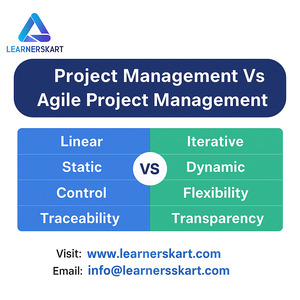
Project Management vs. Agile Project Management: Key Differences, Benefits, and When to Use
In today’s fast-paced business world, choosing the right project management approach can make or break your success. While traditional project management (often known as Waterfall) has been the backbone of industries for decades, Agile project management has quickly become the go-to framework in dynamic environments like IT, startups, and product development.
So, what’s the difference between the two? And more importantly, when should you use which? Let’s break it down.
What is Traditional Project Management?
Traditional project management follows a linear, step-by-step process. Every stage — from initiation to closure — is planned in advance. The goal is to control scope, budget, and timeline with minimal deviation.
-
Best for: Construction, manufacturing, infrastructure, or projects with clear, stable requirements.
-
Process flow: Initiation → Planning → Execution → Monitoring → Closure.
What is Agile Project Management?
Agile project management is iterative and flexible, focusing on short cycles (sprints) to deliver continuous value. Instead of sticking to a rigid plan, Agile adapts to change and emphasizes collaboration.
-
Best for: Software development, R&D, product design, startups, and industries facing frequent change.
-
Process flow: Plan → Build → Review → Adjust (repeated in sprints).
Key Differences Between Project Management and Agile Project Management
| Aspect | Traditional Project Management | Agile Project Management |
|---|---|---|
| Approach | Sequential, linear (Waterfall) | Iterative, incremental (sprints) |
| Flexibility | Limited changes are costly | High, change is welcomed anytime |
| Planning | Heavy upfront planning | Continuous planning per sprint |
| Risk Management | Identified and mitigated early | Managed through feedback and iteration |
| Stakeholder Involvement | Mostly at milestones | Continuous, active collaboration |
| Documentation | Detailed, comprehensive records | Minimal, just enough documentation |
| Team Structure | Hierarchically, the project manager is in control | Flat, self-organizing teams |
| Success Measure | Delivery on time, budget, and scope | Customer satisfaction and adaptability |
Advantages & Disadvantages
Traditional Project Management
✅ Predictable and structured
✅ Clear documentation and accountability
❌ Struggles with change
❌ Slower delivery in dynamic environments
Agile Project Management
✅ Faster delivery of value
✅ High adaptability and stakeholder engagement
❌ Requires cultural change
❌ Harder to scale in regulated industries
When to Use Which Approach?
-
Use Traditional Project Management when:
-
Requirements are fixed.
-
Compliance and regulation demand strict documentation.
-
Projects involve physical deliverables (e.g., construction, engineering).
-
-
Use Agile Project Management when:
-
Requirements are evolving.
-
Speed and adaptability are critical.
-
Projects involve innovation, software, or digital transformation.
-
Industry Insights
📊 According to PMI’s Pulse of the Profession 2023:
-
47% of projects use Agile or hybrid approaches.
-
Agile projects report 64% higher success rates in fast-changing industries compared to traditional methods.
This shows that Agile is not replacing traditional project management — instead, hybrid approaches are rising, combining the strengths of both.
Conclusion
Both traditional project management and Agile project management have unique strengths. The real question is not “which is better” but “which is right for your project.” Smart organizations and project managers often adopt a hybrid approach that blends predictability with flexibility.
How LearnersKart Can Help
At LearnersKart, we provide world-class training in both PMP® (Project Management Professional) and Agile/Scrum methodologies. Our programs equip you with the knowledge and skills to lead projects successfully in any environment.
📩 Learn more: www.learnerskart.com | info@learnerskart.com
#ProjectManagement #AgileProjectManagement #AgilePM #Scrum #Kanban #PMP #PMO #ProjectLeadership #AgileVsTraditional #HybridProjectManagement #WorkplaceProductivity #DigitalTransformation #Learnerskart #PMPTraining #AgileTraining
Tags:
You May Also Like

-
Feb 16, 2026
If you’re planning to apply for the PMP certification in 2026, one important question comes first: “Am I really eligible...
-
Feb 13, 2026
In today’s fast-paced business environment, choosing the right project delivery approach can determine whether your project succeeds or struggles. Organisations...
-
Feb 10, 2026
In today’s fast-paced and increasingly complex business environment, organisations are no longer managing just one or two initiatives at a...
-
Feb 9, 2026
In project management, confusion over who does what and who makes the final decision is one of the biggest reasons...
Sign up to receive our latest updates
Company
Support
Service Offerings
Special Offers
Get in touch
India
Call us directly?
+91-984-459-1589
Address
Learnerskart Solutions Pvt Ltd
4th floor, No: 207/189, 9th Main Rd, 6th Sector,
HSR Layout, Bengaluru, Karnataka 560102
info@learnerskart.com
USA
Call us directly?
+1 (307)-998-3816
Address
Learnerskart Americas LLC
30 N Gould St Ste R
Sheridan, WY 82801
info@learnerskart.com
Quick Contact
Trending Categories
Disclaimer
“PMI®”, “PMBOK®”, “PMP®”, “CAPM®” and “PMI-ACP®” are registered marks of the Project Management Institute, Inc.
ITIL® and PRINCE2® are registered trade marks of AXELOS Limited, used under permission of AXELOS Limited. All rights reserved.
“CSM”, “CST” are Registered Trade Marks of The Scrum Alliance, USA.
