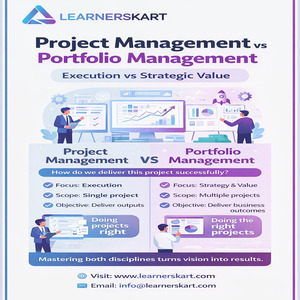
Project Management vs Portfolio Management: Execution vs Strategic Value
-
February 10, 2026
In today’s fast-paced and increasingly complex business environment, organisations are no longer managing just one or two initiatives at a time. They are juggling multiple projects, programs, strategic investments, and innovation efforts simultaneously.
In this context, success depends not only on how well projects are executed, but also on which projects are chosen in the first place. This is where the distinction between Project Management and Portfolio Management—and the roles that support them—becomes critically important.
While both disciplines are essential, they operate at very different levels of decision-making. One focuses on execution, the other on strategic value. Understanding this difference helps organisations deliver better outcomes and helps professionals make informed career decisions.
Understanding Project Management
Project Management is the discipline of planning, executing, monitoring, and closing a specific project to achieve defined objectives within agreed constraints such as scope, time, cost, quality, and risk.
It is the engine that turns ideas into tangible results.
Key Focus Areas
-
Delivering clearly defined project outcomes
-
Managing scope, schedule, cost, risks, and quality
-
Leading cross-functional teams
-
Engaging stakeholders and managing expectations
-
Ensuring customer satisfaction
Key Question Project Management Answers
“How do we deliver this project successfully?”
Project managers are responsible for doing the work right. Their success is measured by whether the project is delivered on time, within budget, and meets stakeholder expectations.
Understanding Portfolio Management
Portfolio Management operates at a higher, strategic level. Instead of managing individual projects, it focuses on selecting, prioritizing, and governing a collection of projects and programs to ensure alignment with organizational goals.
Portfolio management is about investment decisions, not delivery tasks.
Key Focus Areas
-
Aligning initiatives with business strategy
-
Prioritizing projects based on value, risk, and ROI
-
Optimizing resource allocation across initiatives
-
Balancing short-term performance with long-term growth
-
Stopping or reshaping low-value initiatives
Key Question Portfolio Management Answers
“Are we doing the right projects?”
Portfolio managers ensure that limited resources—budget, people, and time—are invested where they generate maximum strategic impact.
Execution vs Strategic Value: The Core Difference
| Aspect | Project Management | Portfolio Management |
|---|---|---|
| Primary Focus | Execution | Strategy & Value |
| Scope | Single project | Multiple projects and programs |
| Objective | Deliver outputs | Deliver business outcomes |
| Time Horizon | Short to medium term | Medium to long term |
| Success Measure | On-time, on-budget delivery | Strategic alignment & ROI |
| Decision Level | Operational | Executive |
In Simple Terms
-
Project Management = Doing projects right
-
Portfolio Management = Doing the right projects
Project Manager vs Portfolio Manager: Role Perspective
Understanding the disciplines becomes even clearer when viewed through the roles that support them.
What Does a Project Manager Do?
A Project Manager is accountable for the successful delivery of a single initiative.
Core Responsibilities
-
Developing project plans and schedules
-
Managing tasks, risks, resources, and budgets
-
Coordinating teams and vendors
-
Tracking progress and reporting status
-
Ensuring deliverables meet quality standards
Primary Goal
Deliver one successful project efficiently and predictably.
What Does a Portfolio Manager Do?
A Portfolio Manager operates at the organizational level, ensuring that all projects collectively support strategic objectives.
Core Responsibilities
-
Prioritizing initiatives based on ROI and risk
-
Allocating resources across multiple projects
-
Reviewing portfolio-level performance
-
Pausing, accelerating, or stopping initiatives
-
Aligning investments with long-term strategy
Primary Goal
Optimize the entire portfolio to maximize business value.
How Project and Portfolio Roles Work Together
These roles are not hierarchical competitors—they are strategic partners.
-
Project Managers ensure execution is smooth and predictable
-
Portfolio Managers ensure the organization is investing in the right work
When both roles collaborate effectively:
-
Resources are used wisely
-
Low-value projects are avoided
-
Strategic goals are achieved faster
-
Business outcomes improve
Why Organizations Need Both
Organizations that focus only on project execution may deliver many projects successfully—yet still fail to achieve strategic goals.
On the other hand, organizations with strong portfolio planning but weak execution discipline may have excellent strategies that never materialize.
High-performing organizations integrate both disciplines:
-
Portfolio Management defines what should be done and why
-
Project Management determines how it gets done
Together, they ensure strategy is not just documented—but delivered.
Career Perspective: Which Path Is Right for You?
-
If you enjoy hands-on planning, working closely with teams, and solving delivery challenges, Project Management may be the ideal path.
-
If you enjoy big-picture thinking, strategic decision-making, and influencing organizational direction, Portfolio Management may be the better fit.
Many professionals begin their careers as project managers and later move into program or portfolio roles as they gain experience in leadership, governance, and strategy.
Final Thoughts
The difference between Project Management and Portfolio Management reflects the difference between execution and strategy.
-
One ensures the work is done right
-
The other ensures the right work is being done
Both are critical. Both create value. And together, they enable organizations to convert vision into measurable results.
For professionals, understanding this distinction is a powerful step toward career growth, leadership readiness, and advanced certifications.
About Learnerskart
Learnerskart provides professional certification training and exam assistance for globally recognized credentials such as PMP®, PgMP®, PfMP®, ITIL®, Lean Six Sigma, and more—helping professionals transform knowledge into career success.
🌐 Visit: www.learnerskart.com | 📧 Email: info@learnerskart.com
✔️ Follow us for PM tips & career insights: https://lnkd.in/gYB4Dw4K
Tags:
You May Also Like
-
Feb 13, 2026
In today’s fast-paced business environment, choosing the right project delivery approach can determine whether your project succeeds or struggles. Organisations...
-
Feb 9, 2026
In project management, confusion over who does what and who makes the final decision is one of the biggest reasons...
-
Feb 6, 2026
Many projects fail not because teams lack effort or expertise—but because they confuse project planning with project strategy. While both...
-
Feb 5, 2026
What Professionals Really Need to Succeed Project management looks perfect in textbooks. Clear processes, defined roles, predictable timelines, and neatly...
Sign up to receive our latest updates
Company
Support
Service Offerings
Special Offers
Get in touch
India
Call us directly?
+91-984-459-1589
Address
Learnerskart Solutions Pvt Ltd
4th floor, No: 207/189, 9th Main Rd, 6th Sector,
HSR Layout, Bengaluru, Karnataka 560102
info@learnerskart.com
USA
Call us directly?
+1 (307)-998-3816
Address
Learnerskart Americas LLC
30 N Gould St Ste R
Sheridan, WY 82801
info@learnerskart.com
Quick Contact
Trending Categories
Disclaimer
“PMI®”, “PMBOK®”, “PMP®”, “CAPM®” and “PMI-ACP®” are registered marks of the Project Management Institute, Inc.
ITIL® and PRINCE2® are registered trade marks of AXELOS Limited, used under permission of AXELOS Limited. All rights reserved.
“CSM”, “CST” are Registered Trade Marks of The Scrum Alliance, USA.
