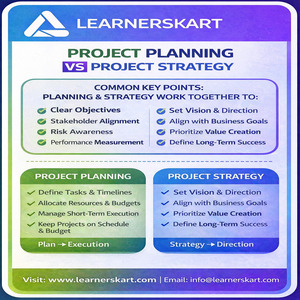
Project Planning vs Project Strategy: Understanding the Difference That Drives Project Success
-
February 6, 2026
Many projects fail not because teams lack effort or expertise—but because they confuse project planning with project strategy.
While both are essential, they serve very different purposes. One focuses on how the work will be executed, while the other defines why the project exists and where it should take the organization.
Understanding the difference between Project Planning and Project Strategy is critical for delivering projects that are not only completed on time and within budget—but also deliver real business value.
What Is Project Planning?
Project planning is the operational backbone of a project. It translates goals into actionable steps and provides a structured roadmap for execution.
Key Characteristics of Project Planning
Project planning focuses on:
-
Defining tasks, activities, and work breakdown structures
-
Establishing timelines, schedules, and milestones
-
Allocating resources (people, materials, tools)
-
Estimating and controlling budgets
-
Identifying risks and planning mitigation actions
-
Managing dependencies and deliverables
In simple terms, project planning answers the question:
👉 “How will we execute this project efficiently?”
Nature of Project Planning
-
Short- to medium-term focus
-
Execution-oriented
-
Detailed and tactical
-
Managed primarily by the project manager and delivery teams
Common Planning KPIs
-
Schedule variance
-
Cost variance
-
Task completion percentage
-
Resource utilization
Project planning ensures control, predictability, and efficiency during execution.
What Is Project Strategy?
Project strategy provides the big-picture direction. It ensures the project exists for the right reasons and contributes to long-term organizational success.
Key Characteristics of Project Strategy
Project strategy focuses on:
-
Aligning the project with business objectives
-
Defining success criteria beyond time and cost
-
Prioritizing value creation
-
Establishing governance and decision frameworks
-
Aligning stakeholders and leadership expectations
-
Supporting competitive advantage and growth
In simple terms, project strategy answers the question:
👉 “Why are we doing this project, and what value should it deliver?”
Nature of Project Strategy
-
Long-term and future-focused
-
Value-driven
-
Directional and adaptive
-
Owned by senior leadership, sponsors, and PMO
Common Strategy KPIs
-
Return on Investment (ROI)
-
Strategic alignment score
-
Business impact
-
Growth or market impact
Project strategy ensures relevance, alignment, and value realization.
Project Planning vs Project Strategy: Key Differences
| Aspect | Project Planning | Project Strategy |
|---|---|---|
| Focus | Execution | Direction |
| Time Horizon | Short-term | Long-term |
| Purpose | Deliver outputs | Deliver outcomes |
| Level | Tactical | Strategic |
| Primary Question | How will we do it? | Why should we do it? |
| Ownership | Project Manager | Sponsor & Leadership |
| Success Measure | On time, on budget | Business value |
Where Planning and Strategy Overlap
Although different, planning and strategy must work together. Their intersection ensures projects are both well-executed and meaningful.
Common overlap areas include:
-
Clear project objectives
-
Stakeholder alignment
-
Risk awareness
-
Performance measurement
-
Governance and reporting
-
Continuous improvement mindset
When strategy defines the destination and planning defines the route, projects move with clarity and purpose.
Why Projects Fail Without Strategic Alignment
Research consistently shows that:
-
Many projects fail due to poor execution or weak planning
-
Leaders emphasize the importance of aligning projects with strategy
-
A lack of clear project strategy is a major cause of project failure
Projects that focus only on planning may deliver outputs—but still fail to deliver business outcomes.
The Right Approach: Strategy First, Planning Second
Successful organizations follow this sequence:
-
Define the project strategy
-
Why is the project needed?
-
How does it support organizational goals?
-
What value defines success?
-
-
Build a strong project plan
-
Translate strategy into tasks, schedules, and budgets
-
Assign responsibilities and manage risks
-
Monitor and control execution
-
This approach ensures projects are doing the right work, not just doing work right.
Final Thoughts
Project planning and project strategy are not interchangeable—they are complementary.
-
Project strategy ensures you are working on the right project
-
Project planning ensures you execute the project the right way
Organizations that master both achieve:
-
Higher success rates
-
Better stakeholder confidence
-
Stronger business impact
In today’s competitive environment, project success is no longer just about delivery—it’s about delivering value with purpose.
Learnerskart helps professionals master both project planning and strategic thinking through globally recognized project management and leadership certification programs.
🌐 Visit: www.learnerskart.com | 📧 Email: info@learnerskart.com
✔️ Follow us for PM tips & career insights: https://lnkd.in/gYB4Dw4K
Tags:
You May Also Like
-
Feb 13, 2026
In today’s fast-paced business environment, choosing the right project delivery approach can determine whether your project succeeds or struggles. Organisations...
-
Feb 10, 2026
In today’s fast-paced and increasingly complex business environment, organisations are no longer managing just one or two initiatives at a...
-
Feb 9, 2026
In project management, confusion over who does what and who makes the final decision is one of the biggest reasons...
-
Feb 5, 2026
What Professionals Really Need to Succeed Project management looks perfect in textbooks. Clear processes, defined roles, predictable timelines, and neatly...
Sign up to receive our latest updates
Company
Support
Service Offerings
Special Offers
Get in touch
India
Call us directly?
+91-984-459-1589
Address
Learnerskart Solutions Pvt Ltd
4th floor, No: 207/189, 9th Main Rd, 6th Sector,
HSR Layout, Bengaluru, Karnataka 560102
info@learnerskart.com
USA
Call us directly?
+1 (307)-998-3816
Address
Learnerskart Americas LLC
30 N Gould St Ste R
Sheridan, WY 82801
info@learnerskart.com
Quick Contact
Trending Categories
Disclaimer
“PMI®”, “PMBOK®”, “PMP®”, “CAPM®” and “PMI-ACP®” are registered marks of the Project Management Institute, Inc.
ITIL® and PRINCE2® are registered trade marks of AXELOS Limited, used under permission of AXELOS Limited. All rights reserved.
“CSM”, “CST” are Registered Trade Marks of The Scrum Alliance, USA.
