Project Status Report: Complete Guide with Real-World Example
-
January 12, 2026
A Project Status Report is one of the most critical communication tools in project management. It provides stakeholders with a clear, concise view of how a project is performing in terms of scope, schedule, cost, risks, and progress. Whether you are managing an IT project, LMS implementation, construction work, or preparing for the PMP® exam, understanding how to create an effective project status report is essential.
In this blog, we’ll cover:
-
What a Project Status Report is
-
Why is it important
-
Key components of a professional status report
-
A real-world project status report example
-
Best practices followed by successful project managers
What Is a Project Status Report?
A Project Status Report is a structured document that summarizes the current health and progress of a project over a specific reporting period. It answers key stakeholder questions such as:
-
Is the project on track?
-
Are we within budget?
-
What has been completed?
-
What risks or issues need attention?
-
What decisions are required?
Project status reports are typically shared weekly, bi-weekly, or monthly, depending on project complexity and stakeholder expectations.
Why Is a Project Status Report Important?
A well-prepared project status report helps to:
-
✅ Improve transparency with stakeholders
-
✅ Identify risks and issues early
-
✅ Track progress against schedule and budget
-
✅ Support informed decision-making
-
✅ Maintain stakeholder confidence
-
✅ Meet PMP® and PMI best practices
Without regular status reporting, projects are more likely to face scope creep, delays, cost overruns, and miscommunication.
Key Components of a Professional Project Status Report
1. Project Overview
This section provides basic project details:
-
Project Name
-
Client / Stakeholder
-
Project Manager
-
Reporting Period
-
Start Date and Planned End Date
It sets context for readers who may not be involved in day-to-day execution.
2. Overall Project Status
This is a high-level health indicator, usually shown as:
-
🟢 On Track
-
🟡 At Risk
-
🔴 Delayed
Include a short status summary (2–3 lines) explaining the current situation.
3. Key Accomplishments
List major achievements completed during the reporting period, such as:
-
Milestones achieved
-
Modules delivered
-
Testing completed
-
Approvals received
This section demonstrates progress and value delivered.
4. Planned Activities (Next Period)
Outline what is planned for the next reporting cycle.
This helps stakeholders understand upcoming work and dependencies.
5. Project Milestones
Milestones track major deliverables and approvals.
Typical milestone table includes:
-
Milestone Name
-
Planned Date
-
Actual Date
-
Status
This provides a quick snapshot of schedule performance.
6. Schedule, Cost & Timeline Performance
This section answers:
-
Are we on schedule?
-
Are we within budget?
Include:
-
Schedule status (On schedule / Delayed)
-
Cost status (Within budget / Over budget)
-
Performance indicators (SPI, CPI if applicable)
-
Timeline or progress percentage
7. Project Budget
A professional report always includes financial visibility:
-
Budgeted Cost
-
Actual Cost
-
Remaining Balance
-
Budget variance (if any)
This is especially important for executive stakeholders.
8. Risks & Issues
Identify current and potential threats to the project:
-
Risk/Issue ID
-
Description
-
Impact level (Low / Medium / High)
-
Mitigation plan
-
Current status
Early risk reporting is a hallmark of mature project management.
9. Dependencies & Constraints
List factors outside the project team’s control that may affect delivery, such as:
-
Client approvals
-
Vendor dependencies
-
Resource availability
10. Change Requests
Document any requested changes to scope, timeline, or cost, along with their approval status.
11. Key Metrics
Summarize project performance using measurable data:
-
Overall progress (%)
-
Tasks completed vs total
-
Open issues
-
Critical issues
12. Decisions Required
Clearly state what decisions or approvals are required from stakeholders to move forward.
Real-World Project Status Report Example (Summary)
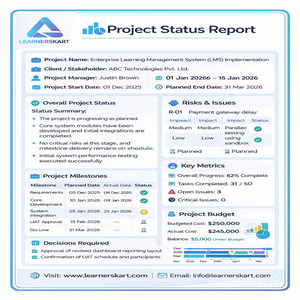
Project: Enterprise Learning Management System (LMS) Implementation
Project Manager: Justin Brown
Overall Status: On Track
Progress: 62% Complete
Budget Status: $5,000 under budget
Schedule Status: On schedule
Critical Issues: 0
This type of concise yet detailed reporting ensures clarity and confidence among all stakeholders.
Best Practices for Effective Project Status Reporting
-
🔹 Keep it concise and visual
-
🔹 Focus on facts, not assumptions
-
🔹 Highlight risks early—don’t hide issues
-
🔹 Use consistent formats and reporting periods
-
🔹 Align reports with PMI® and PMP® standards
-
🔹 Customize detail level based on audience
Project Status Reports and PMP® Exam Preparation
Understanding project status reporting is crucial for:
-
PMP® certification preparation
-
Real-world project management roles
-
Stakeholder communication scenarios
At Learnerskart, we emphasize practical, exam-focused learning that helps professionals apply PMI concepts confidently in real projects.
Conclusion
A Project Status Report is more than a document—it is a leadership and communication tool. When prepared correctly, it helps project managers stay in control, build trust, and deliver successful outcomes.
Whether you are managing a live project or preparing for the PMP® exam, mastering project status reporting is a must-have skill.
🚀 Learn Project Management the Right Way with Learnerskart
🌐 Visit: www.learnerskart.com | 📧 Email: info@learnerskart.com
✔️ Follow us for more project management tips & career insights! https://lnkd.in/gYB4Dw4K
mailto:info@learnerskart.com
Tags:
LMS Implementation ProjectPMI Project ManagementPMP Project Status ReportProject Dashboard ReportingProject Management ReportingProject Manager ReportingProject Milestone TrackingProject Progress ReportProject Reporting Best PracticesProject Risk and Issue ManagementProject Schedule and Budget TrackingProject Status ReportProject Status Report ExampleProject Status Report Template
You May Also Like

-
Feb 16, 2026
If you’re planning to apply for the PMP certification in 2026, one important question comes first: “Am I really eligible...
-
Feb 13, 2026
In today’s fast-paced business environment, choosing the right project delivery approach can determine whether your project succeeds or struggles. Organisations...
-
Feb 10, 2026
In today’s fast-paced and increasingly complex business environment, organisations are no longer managing just one or two initiatives at a...
-
Feb 9, 2026
In project management, confusion over who does what and who makes the final decision is one of the biggest reasons...
Sign up to receive our latest updates
Company
Support
Service Offerings
Special Offers
Get in touch
India
Call us directly?
+91-984-459-1589
Address
Learnerskart Solutions Pvt Ltd
4th floor, No: 207/189, 9th Main Rd, 6th Sector,
HSR Layout, Bengaluru, Karnataka 560102
info@learnerskart.com
USA
Call us directly?
+1 (307)-998-3816
Address
Learnerskart Americas LLC
30 N Gould St Ste R
Sheridan, WY 82801
info@learnerskart.com
Quick Contact
Trending Categories
Disclaimer
“PMI®”, “PMBOK®”, “PMP®”, “CAPM®” and “PMI-ACP®” are registered marks of the Project Management Institute, Inc.
ITIL® and PRINCE2® are registered trade marks of AXELOS Limited, used under permission of AXELOS Limited. All rights reserved.
“CSM”, “CST” are Registered Trade Marks of The Scrum Alliance, USA.
