Top 10 Project Management Knowledge Areas & Why Risk Management Is the Hardest | Learnerskart
-
September 1, 2025
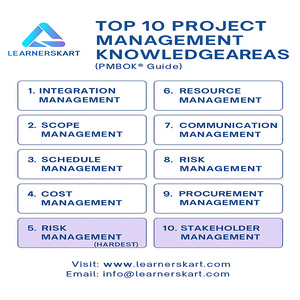
🌟 Top 10 Project Management Knowledge Areas (PMBOK® Guide) & Why Risk Management Is the Hardest
Project Management is more than just meeting deadlines and budgets—it’s about ensuring every moving part of a project aligns toward success. According to the PMBOK® Guide (Project Management Body of Knowledge), there are 10 knowledge areas every project manager must master. Some are straightforward, while others require deeper skills, foresight, and adaptability.
In this blog, we’ll cover the top 10 knowledge areas, highlight the hardest one to master, explore the risks of poor handling, and provide practical tips to overcome challenges.
✅ The 10 Project Management Knowledge Areas
-
Integration Management – Ensuring all project parts work together seamlessly.
-
Scope Management – Defining project boundaries—what’s included and what’s excluded.
-
Schedule Management – Creating and controlling the project timeline.
-
Cost Management – Budgeting, estimating, and controlling expenses.
-
Quality Management – Delivering outputs that meet agreed standards.
-
Resource Management – Managing people, tools, and materials effectively.
-
Communication Management – Establishing clear, consistent, and timely communication.
-
Risk Management – Identifying and addressing uncertainties before they become problems.
-
Procurement Management – Managing vendor contracts and third-party relationships.
-
Stakeholder Management – Engaging and aligning people with different priorities.
💡 The Hardest Knowledge Areas
While all 10 are essential, Risk Management and Stakeholder Management often challenge even the most experienced project managers.
Why Risk Management is the Hardest
-
Uncertainty: Risks involve unpredictable future events.
-
Hidden Threats: Some risks remain invisible until they strike (“unknown unknowns”).
-
Dynamic Nature: Risks evolve as the project progresses.
-
Stakeholder Resistance: Many hesitate to invest in “what-if” scenarios.
-
High Impact: Poor risk management can derail entire projects.
⚠️ Risks of Ignoring Strong Risk Management
If risk management is weak or neglected, projects face high chances of failure:
-
Missed Deadlines – High probability due to unforeseen delays.
-
Cost Overruns – Medium–high risk without early planning.
-
Scope Creep – Risks can trigger unplanned work.
-
Stakeholder Dissatisfaction – Confidence erodes with frequent surprises.
-
Project Failure – Studies suggest 60–70% of project failures are linked to poor risk management.
💡 Tips to Master Risk Management
-
Run Risk Identification Workshops – Use brainstorming, expert input, and historical data.
-
Maintain a Risk Register – Track risks, probability, impact, owner, and response plan.
-
Prioritize Risks – Use qualitative (probability-impact matrix) and quantitative (Monte Carlo simulations, EMV).
-
Develop Response Strategies – Avoid, Transfer, Mitigate, or Accept.
-
Monitor Continuously – Update risks at every review meeting.
-
Communicate Transparently – Keep stakeholders engaged and informed.
-
Learn from Past Projects – Reuse lessons to anticipate future risks.
✅ Conclusion
Risk Management is the hardest project management knowledge area because it requires constant vigilance, foresight, and flexibility. But with a proactive mindset, structured tools like a Risk Register, and continuous stakeholder engagement, project managers can greatly increase their chances of delivering on time, on budget, and with satisfied stakeholders.
At LearnersKart, we help project managers simplify complex concepts through:
-
Real-world case studies
-
Hands-on exercises
-
Expert-led training
📩 Reach us at info@learnerskart.com
🌐 Visit us at www.learnerskart.com
Project Management Knowledge Areas, PMBOK Guide, PMP Certification, Risk Management in Projects, Stakeholder Management, Project Success, Project Failure, Project Management Training.
Tags:
You May Also Like

-
Feb 17, 2026
When someone says, “I’m a Project Manager,” it sounds straightforward. But the reality is far more complex. A Project Manager...

-
Feb 16, 2026
If you’re planning to apply for the PMP certification in 2026, one important question comes first: “Am I really eligible...
-
Feb 13, 2026
In today’s fast-paced business environment, choosing the right project delivery approach can determine whether your project succeeds or struggles. Organisations...
-
Feb 10, 2026
In today’s fast-paced and increasingly complex business environment, organisations are no longer managing just one or two initiatives at a...
Sign up to receive our latest updates
Company
Support
Service Offerings
Special Offers
Get in touch
India
Call us directly?
+91-984-459-1589
Address
Learnerskart Solutions Pvt Ltd
4th floor, No: 207/189, 9th Main Rd, 6th Sector,
HSR Layout, Bengaluru, Karnataka 560102
info@learnerskart.com
USA
Call us directly?
+1 (307)-998-3816
Address
Learnerskart Americas LLC
30 N Gould St Ste R
Sheridan, WY 82801
info@learnerskart.com
Quick Contact
Trending Categories
Disclaimer
“PMI®”, “PMBOK®”, “PMP®”, “CAPM®” and “PMI-ACP®” are registered marks of the Project Management Institute, Inc.
ITIL® and PRINCE2® are registered trade marks of AXELOS Limited, used under permission of AXELOS Limited. All rights reserved.
“CSM”, “CST” are Registered Trade Marks of The Scrum Alliance, USA.
