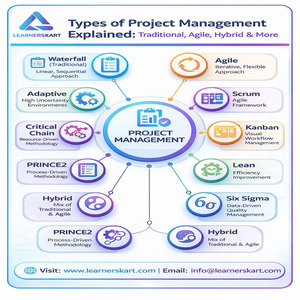
Types of Project Management Explained: Traditional, Agile, Hybrid & More
-
December 23, 2025
Project management is not a one-size-fits-all discipline. Different projects require different approaches depending on scope, complexity, uncertainty, and stakeholder expectations. Choosing the right project management approach can significantly impact project success.
In this guide, we’ll explain the major types of project management, their key characteristics, and when to use each—making it easy for professionals, PMP® aspirants, and organizations to select the right method.
What Is Project Management?
Project management is the application of knowledge, skills, tools, and techniques to project activities to meet project requirements. According to PMI, it involves balancing scope, schedule, cost, quality, risk, and stakeholder expectations.
Why Are There Different Types of Project Management?
Projects vary in:
-
Level of uncertainty
-
Speed of delivery
-
Regulatory constraints
-
Resource availability
-
Customer involvement
Because of this, multiple project management methodologies and approaches have evolved to handle different environments effectively.
1. Traditional Project Management (Waterfall)
Traditional or Waterfall Project Management follows a linear and sequential structure where each phase must be completed before moving to the next.
Key Characteristics:
-
Clearly defined scope and requirements
-
Detailed upfront planning
-
Strict change control
-
Documentation-heavy
Best Suited For:
-
Construction projects
-
Manufacturing
-
Infrastructure and engineering
Example:
Building a highway or commercial building where requirements are fixed.
2. Agile Project Management
Agile Project Management focuses on flexibility, collaboration, and continuous customer feedback. Work is delivered in small increments rather than all at once.
Key Characteristics:
-
Iterative and incremental delivery
-
High customer involvement
-
Embraces change
-
Lightweight documentation
Best Suited For:
-
Software development
-
Digital products
-
Innovation-driven projects
Example:
Developing a mobile or web application.
3. Scrum (Agile Framework)
Scrum is one of the most popular Agile frameworks and emphasizes teamwork, accountability, and short delivery cycles called sprints.
Key Characteristics:
-
Defined roles (Product Owner, Scrum Master, Team)
-
Time-boxed sprints (1–4 weeks)
-
Daily stand-up meetings
-
Continuous improvement
Best Suited For:
-
Complex product development
-
Rapidly changing requirements
4. Kanban
Kanban is a visual workflow management approach focused on improving flow and efficiency.
Key Characteristics:
-
Visual Kanban boards
-
Work-in-Progress (WIP) limits
-
Continuous delivery model
Best Suited For:
-
Support teams
-
Maintenance projects
-
Operational work
5. Lean Project Management
Lean project management aims to maximize value while minimizing waste, inspired by Lean manufacturing principles.
Key Characteristics:
-
Focus on customer value
-
Elimination of non-value-adding activities
-
Continuous improvement (Kaizen)
Best Suited For:
-
Process improvement initiatives
-
Manufacturing and operations
6. Six Sigma
Six Sigma is a data-driven methodology focused on improving quality by reducing defects and variability.
Key Characteristics:
-
DMAIC framework (Define, Measure, Analyze, Improve, Control)
-
Strong use of data and statistics
-
Quality and performance improvement
Best Suited For:
-
Quality improvement projects
-
Process optimization
7. Hybrid Project Management
Hybrid Project Management combines traditional (Waterfall) and Agile approaches to leverage the strengths of both.
Key Characteristics:
-
Upfront planning with flexible execution
-
Tailored approach based on project needs
Best Suited For:
-
Large enterprise projects
-
Projects with fixed deadlines but evolving requirements
8. PRINCE2 (Projects IN Controlled Environments)
PRINCE2 is a structured, process-driven methodology widely used in the UK and Europe.
Key Characteristics:
-
Strong governance and control
-
Clearly defined roles and responsibilities
-
Stage-based project management
Best Suited For:
-
Government projects
-
Highly regulated industries
9. Critical Chain Project Management (CCPM)
CCPM focuses on managing resource constraints and minimizing project delays using buffer management.
Key Characteristics:
-
Resource-driven scheduling
-
Reduced multitasking
-
Focus on the critical chain rather than the critical path
Best Suited For:
-
Resource-constrained environments
10. Adaptive Project Management
Adaptive project management is used when project requirements are highly uncertain or evolving.
Key Characteristics:
-
Continuous learning and adjustment
-
Flexible planning
-
Rapid response to change
Best Suited For:
-
Research and development (R&D)
-
Innovation and experimental projects
Comparison Summary
| Type | Best Use Case |
|---|---|
| Waterfall | Stable, predictable projects |
| Agile | Dynamic and evolving projects |
| Scrum | Team-based product development |
| Kanban | Continuous workflow management |
| Lean | Efficiency and waste reduction |
| Six Sigma | Quality improvement |
| Hybrid | Mixed project environments |
| PRINCE2 | Governance-heavy projects |
| CCPM | Resource-constrained projects |
| Adaptive | High-uncertainty projects |
Which Project Management Type Should You Choose?
Choosing the right approach depends on:
-
Project complexity
-
Industry and regulations
-
Customer involvement
-
Level of uncertainty
Modern organizations often adopt Hybrid or Agile approaches to remain competitive.
Final Thoughts
Understanding the different types of project management helps professionals deliver better results, pass PMP® exams, and align projects with business goals. No single approach is superior—success lies in selecting the right method for the right project.
Want to Become a Certified Project Management Professional?
Learnerskart offers PMP®, CAPM®, PRINCE2®, Agile, Lean Six Sigma, and Digital Marketing training designed for working professionals.
🌐 Visit: www.learnerskart.com | 📧 Email: info@learnerskart.com
✔️ Follow us for more project management tips & career insights! https://lnkd.in/gYB4Dw4K
Tags:
You May Also Like

-
Feb 16, 2026
If you’re planning to apply for the PMP certification in 2026, one important question comes first: “Am I really eligible...
-
Feb 13, 2026
In today’s fast-paced business environment, choosing the right project delivery approach can determine whether your project succeeds or struggles. Organisations...
-
Feb 10, 2026
In today’s fast-paced and increasingly complex business environment, organisations are no longer managing just one or two initiatives at a...
-
Feb 9, 2026
In project management, confusion over who does what and who makes the final decision is one of the biggest reasons...
Sign up to receive our latest updates
Company
Support
Service Offerings
Special Offers
Get in touch
India
Call us directly?
+91-984-459-1589
Address
Learnerskart Solutions Pvt Ltd
4th floor, No: 207/189, 9th Main Rd, 6th Sector,
HSR Layout, Bengaluru, Karnataka 560102
info@learnerskart.com
USA
Call us directly?
+1 (307)-998-3816
Address
Learnerskart Americas LLC
30 N Gould St Ste R
Sheridan, WY 82801
info@learnerskart.com
Quick Contact
Trending Categories
Disclaimer
“PMI®”, “PMBOK®”, “PMP®”, “CAPM®” and “PMI-ACP®” are registered marks of the Project Management Institute, Inc.
ITIL® and PRINCE2® are registered trade marks of AXELOS Limited, used under permission of AXELOS Limited. All rights reserved.
“CSM”, “CST” are Registered Trade Marks of The Scrum Alliance, USA.
