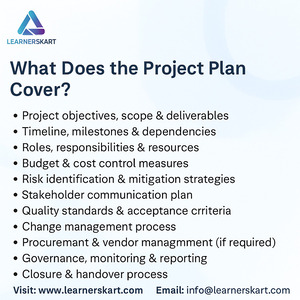
What Does the Project Plan Cover? | Learnerskart
-
September 24, 2025
A project plan is more than just a schedule. It’s the complete roadmap that guides a project from initiation to successful closure. Without a clear and detailed plan, even the most skilled teams can lose track of objectives, overspend budgets, or miss deadlines.
So, what exactly does a project plan cover? Let’s break it down.
1. Project Objectives, Scope & Deliverables
Every project begins with clarity. The plan defines what the project aims to achieve, what’s included in scope, and what the key deliverables will be. This ensures all stakeholders share the same vision.
2. Timeline, Milestones & Dependencies
A detailed schedule shows how work will be carried out, when milestones will be achieved, and how tasks depend on one another. This prevents bottlenecks and keeps everyone aligned.
3. Roles, Responsibilities & Resources
Who is doing what? The project plan defines roles, responsibilities, and the resources required (people, tools, finances, and materials) to get the work done.
4. Budget & Cost Control Measures
No project runs without costs. The plan outlines the estimated budget, cost baselines, and measures to track and control spending.
5. Risk Identification & Mitigation Strategies
Risks are inevitable, but a good plan identifies them early. It includes potential risks, their likelihood, impact, and contingency strategies to minimize disruptions.
6. Stakeholder Communication Plan
Successful projects thrive on effective communication. The plan defines who needs what information, when, and how it will be shared—whether through reports, meetings, or dashboards.
7. Quality Standards & Acceptance Criteria
Deliverables must meet expectations. The plan establishes quality standards, testing approaches, and acceptance criteria to ensure that outputs meet the agreed-upon requirements.
8. Change Management Process
Scope creep is a common challenge. The plan outlines a clear process for handling changes: request, review, approval, and implementation.
9. Procurement & Vendor Management
If third-party vendors or contractors are involved, the plan includes procurement strategies, contracts, and vendor management practices.
10. Governance, Monitoring & Reporting
To stay on track, the plan defines governance structures, monitoring tools (KPIs, dashboards), and reporting frequency.
11. Assumptions & Constraints
Every project is based on certain assumptions and limitations—such as time, budget, resources, or technology—that are documented for transparency.
12. Closure & Handover Process
Finally, the plan outlines how the project will be formally closed, deliverables will be handed over, and lessons learned will be captured for future improvement.
✅ Why It Matters
A project plan ensures that the project team, stakeholders, and sponsors are aligned on what will be done, how it will be achieved, when it will be completed, and with what resources. It transforms complexity into clarity and uncertainty into measurable success.
📌 At Learnerskart, we train professionals to master project management practices with globally recognized certifications like PMP®, PRINCE2®, and Lean Six Sigma. Whether you’re starting your career or aiming for leadership roles, we help you gain the skills and credentials needed to stand out.
📩 Connect with us:
🌐 Visit: www.learnerskart.com | 📧 Email: info@learnerskart.com
✔️ Follow us for more project management tips & career insights! https://lnkd.in/gYB4Dw4K
Tags:
elements of a project planLearnersKart Project ManagementPMP project planproject plan checklistproject plan componentsproject plan deliverablesproject plan exampleproject plan templateproject planning in project managementproject planning stepsscope schedule cost risks project planwhat does the project plan cover
You May Also Like

-
Feb 17, 2026
When someone says, “I’m a Project Manager,” it sounds straightforward. But the reality is far more complex. A Project Manager...

-
Feb 16, 2026
If you’re planning to apply for the PMP certification in 2026, one important question comes first: “Am I really eligible...
-
Feb 13, 2026
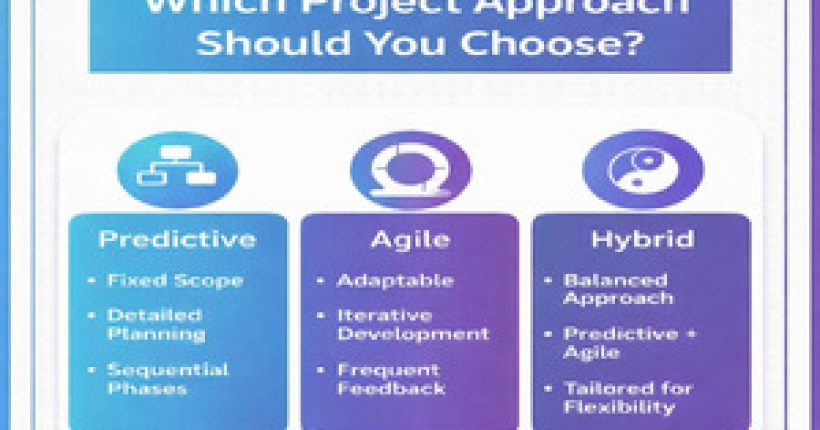
In today’s fast-paced business environment, choosing the right project delivery approach can determine whether your project succeeds or struggles. Organisations...
-
Feb 10, 2026
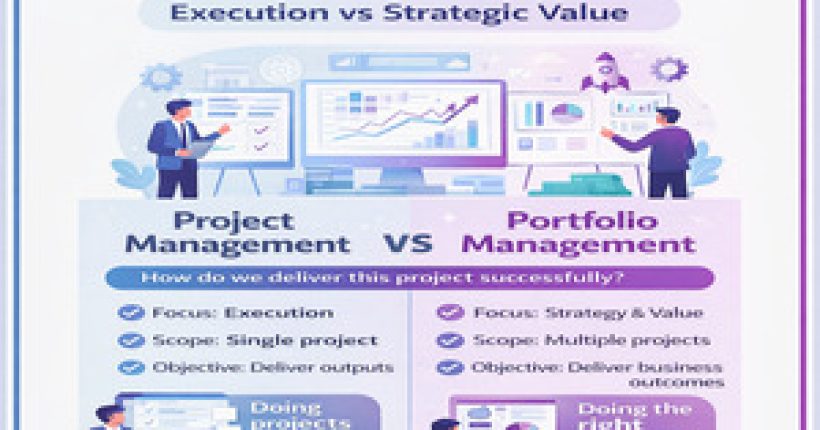
In today’s fast-paced and increasingly complex business environment, organisations are no longer managing just one or two initiatives at a...
Sign up to receive our latest updates
Company
Support
Service Offerings
Special Offers
Get in touch
India
Call us directly?
+91-984-459-1589
Address
Learnerskart Solutions Pvt Ltd
4th floor, No: 207/189, 9th Main Rd, 6th Sector,
HSR Layout, Bengaluru, Karnataka 560102
info@learnerskart.com
USA
Call us directly?
+1 (307)-998-3816
Address
Learnerskart Americas LLC
30 N Gould St Ste R
Sheridan, WY 82801
info@learnerskart.com
Quick Contact
Trending Categories
Disclaimer
“PMI®”, “PMBOK®”, “PMP®”, “CAPM®” and “PMI-ACP®” are registered marks of the Project Management Institute, Inc.
ITIL® and PRINCE2® are registered trade marks of AXELOS Limited, used under permission of AXELOS Limited. All rights reserved.
“CSM”, “CST” are Registered Trade Marks of The Scrum Alliance, USA.
