What is a RAID Log in Project Management? A Complete Guide with Examples
-
November 11, 2025
In project management, staying on top of every moving piece can be challenging. Deadlines shift, risks emerge, and new dependencies arise unexpectedly.
That’s why successful project managers rely on a RAID Log — a powerful tool that helps track and manage key project factors effectively.
Let’s dive deeper into what a RAID Log is, why it’s important, and how you can use it to keep your projects on track.
🔹 What is a RAID Log?
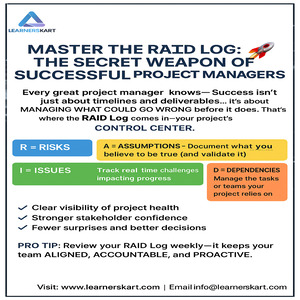
A RAID Log is a structured document used by project managers to record and monitor four critical project elements:
| Acronym | Meaning | Purpose |
|---|---|---|
| R | Risks | Identify potential problems that could impact project success. |
| A | Assumptions | Document things believed to be true for planning, but not yet verified. |
| I | Issues | Track real challenges or blockers affecting progress. |
| D | Dependencies | Manage tasks or deliverables that rely on other tasks or teams. |
In simple terms, the RAID Log acts as the project’s control center, giving visibility into what could go wrong — and how to fix it before it does.
🎯 Why a RAID Log is Important
A RAID Log isn’t just a checklist. It’s a proactive management tool that helps you:
✅ Improve visibility for all stakeholders
✅ Minimize last-minute surprises and escalations
✅ Strengthen accountability across the team
✅ Support better decision-making
✅ Keep your project aligned with goals and timelines
When maintained consistently, a RAID Log helps project managers stay ahead of risks rather than react to them.
🧩 How to Create a RAID Log
You can create a RAID Log easily using Excel, Google Sheets, or any project management tool like MS Project, Smartsheet, or ClickUp.
Here’s a simple example layout:
| Type | Description | Owner | Status | Action Plan |
|---|---|---|---|---|
| Risk | Vendor delay in equipment delivery | John | Open | Identify an alternate supplier |
| Assumption | Team members available full-time | PM | Valid | Review weekly workload |
| Issue | Budget overrun due to scope change | Sarah | Open | Escalate for approval |
| Dependency | API integration from IT team | David | Pending | Track progress weekly |
💡 Best Practices for Maintaining a RAID Log
To get the most value from your RAID Log, follow these best practices:
-
Update regularly — ideally once a week during team meetings.
-
Assign clear ownership for each item.
-
Keep it concise — focus on high-impact items.
-
Share updates with stakeholders consistently.
-
Close out items once resolved to keep focus on active ones.
🚀 Benefits of Using a RAID Log
Using a RAID Log offers tangible benefits, such as:
-
Improved project transparency
-
Better communication and stakeholder trust
-
Faster issue resolution
-
Reduced project risks
-
Clear project documentation for audits and lessons learned
🧠 Pro Tip
Review your RAID Log weekly — it helps your team stay aligned, accountable, and proactive.
Make it a living document, not a static file.
🏁 Conclusion
A RAID Log is a simple yet powerful tool that brings structure and control to your projects.
By capturing Risks, Assumptions, Issues, and Dependencies, you can ensure that nothing slips through the cracks and every decision is backed by data and awareness.
Start implementing a RAID Log in your next project — and watch your project management efficiency soar.
📘 About LearnersKart
LearnersKart.com provides globally recognized professional certification training courses designed to empower professionals, job seekers, and project managers to achieve career success.
Our most popular certifications include:
-
PMP®, PRINCE2®, Lean Six Sigma, ITIL®, Agile, and Business Analysis
🌐 Visit: www.learnerskart.com | 📧 Email: info@learnerskart.com
✔️ Follow us for more project management tips & career insights! https://lnkd.in/gYB4Dw4K
LearnersKart —Learn, Certify, Lead with Confidence.
Tags:
You May Also Like

-
Feb 13, 2026
In today’s fast-paced business environment, choosing the right project delivery approach can determine whether your project succeeds or struggles. Organisations...

-
Feb 10, 2026
In today’s fast-paced and increasingly complex business environment, organisations are no longer managing just one or two initiatives at a...
-
Feb 9, 2026
In project management, confusion over who does what and who makes the final decision is one of the biggest reasons...
-
Feb 6, 2026
Many projects fail not because teams lack effort or expertise—but because they confuse project planning with project strategy. While both...
Sign up to receive our latest updates
Company
Support
Service Offerings
Special Offers
Get in touch
India
Call us directly?
+91-984-459-1589
Address
Learnerskart Solutions Pvt Ltd
4th floor, No: 207/189, 9th Main Rd, 6th Sector,
HSR Layout, Bengaluru, Karnataka 560102
info@learnerskart.com
USA
Call us directly?
+1 (307)-998-3816
Address
Learnerskart Americas LLC
30 N Gould St Ste R
Sheridan, WY 82801
info@learnerskart.com
Quick Contact
Trending Categories
Disclaimer
“PMI®”, “PMBOK®”, “PMP®”, “CAPM®” and “PMI-ACP®” are registered marks of the Project Management Institute, Inc.
ITIL® and PRINCE2® are registered trade marks of AXELOS Limited, used under permission of AXELOS Limited. All rights reserved.
“CSM”, “CST” are Registered Trade Marks of The Scrum Alliance, USA.
