What is RAID in Project Management? A Complete Guide – Learnerskart
-
August 14, 2025
RAID in Project Management: A Complete Guide for Successful Project Delivery
In the world of project management, one simple framework can dramatically improve your ability to deliver on time, within scope, and with confidence — the RAID framework.
At LearnersKart, we train PMP® aspirants and project managers to master this essential tool for project success. Whether you’re working on an Agile sprint, a large enterprise program, or a one-time project, understanding RAID is non-negotiable.
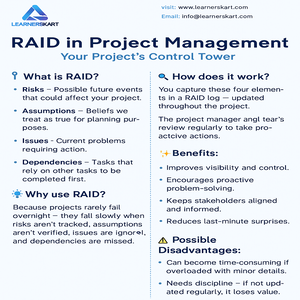
What is RAID in Project Management?
RAID stands for:
-
Risks – Potential future events that could have a positive or negative impact on the project.
-
Assumptions – Factors you accept as true without complete proof, used for planning purposes.
-
Issues – Current problems or challenges that require immediate resolution.
-
Dependencies – Relationships where one task or deliverable relies on another being completed first.
By tracking these four elements in a structured way, project managers can anticipate problems, make informed decisions, and keep stakeholders aligned.
How to Use a RAID Log
A RAID log is a living document where you record, update, and review your project’s risks, assumptions, issues, and dependencies.
Steps to Create and Maintain a RAID Log:
-
Identify – Brainstorm with your team to capture all relevant items.
-
Categorize – Group them under the correct RAID headings.
-
Assign Ownership – Make sure each item has a responsible person.
-
Review Regularly – Schedule weekly or bi-weekly check-ins.
-
Update Actions – Record progress, mitigation strategies, or resolutions.
Why RAID Matters for Project Managers
Many projects fail not because of poor planning, but because small issues snowball into big problems. RAID acts as your early warning system, allowing you to address challenges before they derail your project.
Benefits of Using RAID in Project Management
✅ Enhanced Visibility – Everyone knows the potential risks and current issues.
✅ Proactive Decision-Making – Act before problems escalate.
✅ Stakeholder Alignment – Transparency builds trust.
✅ Reduced Surprises – No more last-minute firefighting.
Advantages of RAID
-
Simple and easy to understand.
-
Adaptable to Agile, Waterfall, or hybrid methodologies.
-
Scales for small, medium, or large projects.
Possible Disadvantages
-
It can become time-consuming if overloaded with minor details.
-
Needs consistent updates to remain effective.
Best Practices for Managing a RAID Log
-
Keep it concise — only track items that matter.
-
Assign clear owners for each item.
-
Review in every project status meeting.
-
Use digital tools for better collaboration (e.g., Excel, Google Sheets, Jira, Trello).
Final Thoughts
If you want to manage projects like a pro, RAID is a must-have tool in your project management toolkit. At LearnersKart, we guide PMP® aspirants and professionals in mastering frameworks like RAID to achieve first-attempt success in the PMP® exam and excel in real-world project delivery.
📌 Ready to elevate your project management skills?
Visit: www.learnerskart.com
Email: info@learnerskart.com
Tags: RAID in project management, RAID log, Risks Assumptions Issues Dependencies, project management tools, PMP certification training, project risk management, project planning best practices, LearnersKart PMP training.
Tags:
You May Also Like

-
Feb 16, 2026
If you’re planning to apply for the PMP certification in 2026, one important question comes first: “Am I really eligible...
-
Feb 13, 2026
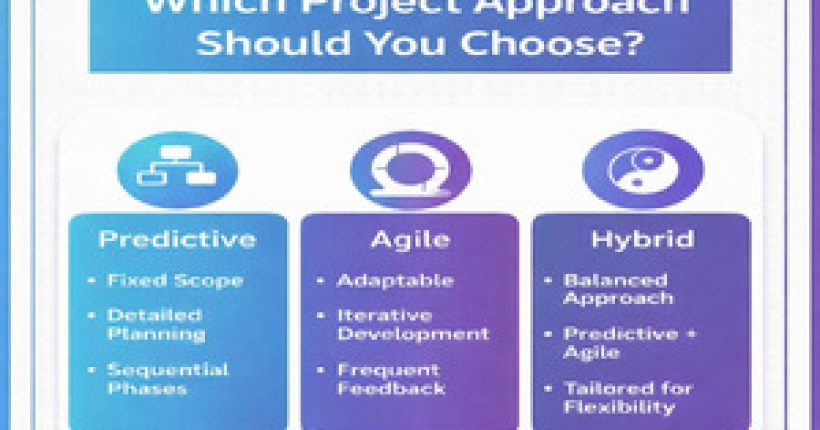
In today’s fast-paced business environment, choosing the right project delivery approach can determine whether your project succeeds or struggles. Organisations...

-
Feb 10, 2026
In today’s fast-paced and increasingly complex business environment, organisations are no longer managing just one or two initiatives at a...
-
Feb 9, 2026
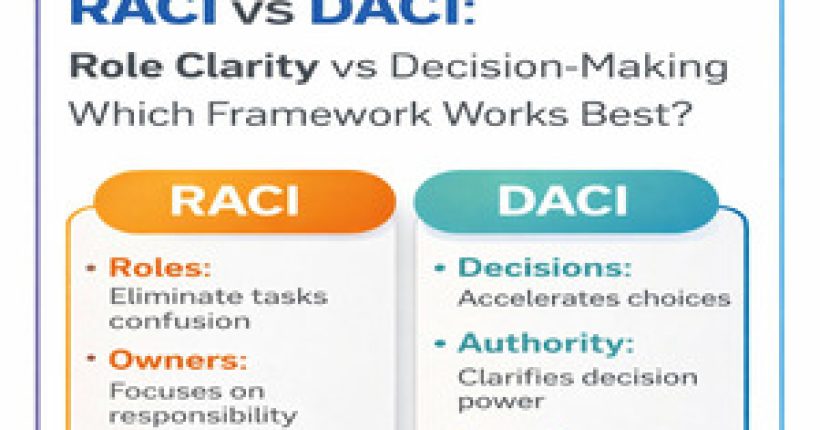
In project management, confusion over who does what and who makes the final decision is one of the biggest reasons...
Sign up to receive our latest updates
Company
Support
Service Offerings
Special Offers
Get in touch
India
Call us directly?
+91-984-459-1589
Address
Learnerskart Solutions Pvt Ltd
4th floor, No: 207/189, 9th Main Rd, 6th Sector,
HSR Layout, Bengaluru, Karnataka 560102
info@learnerskart.com
USA
Call us directly?
+1 (307)-998-3816
Address
Learnerskart Americas LLC
30 N Gould St Ste R
Sheridan, WY 82801
info@learnerskart.com
Quick Contact
Trending Categories
Disclaimer
“PMI®”, “PMBOK®”, “PMP®”, “CAPM®” and “PMI-ACP®” are registered marks of the Project Management Institute, Inc.
ITIL® and PRINCE2® are registered trade marks of AXELOS Limited, used under permission of AXELOS Limited. All rights reserved.
“CSM”, “CST” are Registered Trade Marks of The Scrum Alliance, USA.
