What Is the Critical Path Method (CPM) in Project Management? A Complete Step-by-Step Guide
-
November 18, 2025
In project management, deadlines decide everything. Whether you’re launching a product, constructing a building, or delivering a client project, timing determines success.
To manage time effectively, project managers rely on a powerful scheduling tool — the Critical Path Method (CPM).
CPM helps you identify the most important tasks, estimate the true duration of a project, and predict where delays will occur before they actually happen.
This guide by LearnersKart explains CPM in simple terms, along with how, why, and when to use it.
What Is the Critical Path Method (CPM)?
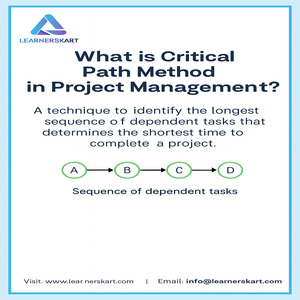
The Critical Path Method is a project scheduling technique used to determine the longest sequence of dependent activities that defines the time required to complete a project.
In simple terms:
👉 The critical path = the tasks you must finish on time or your whole project gets delayed.
Tasks on the critical path have zero float, meaning you cannot delay them without affecting the final delivery date.
Why CPM Is Used in Project Management
PMs use CPM because it provides clear visibility into the project timeline and helps prevent unwanted delays.
✔ Benefits of using CPM:
-
Identifies tasks that influence the project deadline
-
Shows where you have flexibility (float/slack)
-
Improves planning & forecasting
-
Helps allocate resources efficiently
-
Allows you to manage risks proactively
-
Simplifies progress tracking
From IT to construction, CPM is used worldwide because it brings clarity, control, and confidence to complex projects.
When Should You Use CPM?
Use CPM when:
✔ Your project has multiple task dependencies
Example: Design → Develop → Test → Deploy
✔ Your deadlines are strict
CPM ensures you understand which tasks you absolutely cannot delay.
✔ You need clear resource planning
CPM shows where to put your best people.
✔ Managing delays early is important
You’ll know risks before they become problems.
Industries using CPM:
-
Construction
-
Software development
-
Manufacturing
-
Engineering
-
Event management
-
Infrastructure
-
Product launches
How Does CPM Work? (Step-by-Step)
Step 1: List all project activities
Create a complete tasks list.
Step 2: Identify dependencies
Which tasks rely on others?
Example:
Task B depends on Task A.
Step 3: Estimate task duration
Time needed to complete each activity.
Step 4: Create a network diagram
This shows task flow.
Step 5: Calculate Early Start (ES) & Early Finish (EF)
Determine the earliest times tasks can begin/finish.
Step 6: Calculate Late Start (LS) & Late Finish (LF)
Find the latest start/finish times without delaying the project.
Step 7: Identify Float (Slack)
Float = LS – ES
Float = LF – EF
Tasks with zero float = Critical Path
Example of a Critical Path
Consider this sequence:
A → B → C → D
Duration:
A=4 days
B=3 days
C=6 days
D=2 days
Total project duration = 15 days
Any delay in A, B, C, or D delays the entire project.
This sequence is the critical path.
Advantages of CPM
✔ 1. Accurate project scheduling
You know exactly how long the project will take.
✔ 2. Better control over deadlines
Focus on tasks that determine final delivery.
✔ 3. Improved resource allocation
Assign manpower to critical activities.
✔ 4. Early identification of delays
Fix problems before they affect the timeline.
✔ 5. Better communication
Teams know which tasks are high priority.
✔ 6. Stronger risk management
CPM highlights risks hidden within the schedule.
Disadvantages of CPM
✘ 1. Requires accurate information
Incorrect time estimates = incorrect critical path.
✘ 2. Not ideal for unpredictable work
Agile projects with fast-changing requirements may struggle.
✘ 3. Can become complex
Large projects may require tools like MS Project, Primavera, or Workfront.
✘ 4. Needs regular updates
Any change in task duration requires recalculation.
Uses of CPM in Real Projects
✔ Construction
Scheduling foundation → framing → plumbing → electrical → finishing
✔ Software development
Requirements → design → coding → testing → deployment
✔ Event planning
Venue → logistics → setup → execution
✔ Manufacturing
Material setup → assembly → quality check → packaging
✔ Marketing campaigns
Research → content → design → launch
Conclusion
The Critical Path Method is one of the most reliable and effective scheduling techniques in project management.
It helps project managers plan smarter, identify high-risk tasks, avoid delays, and deliver confidently.
For individuals and teams who want to master professional project management, tools like CPM are essential — and LearnersKart brings these concepts to life through simplified training and practical knowledge.
Key Takeaways
-
CPM identifies the longest sequence of tasks
-
Tasks with zero float form the critical path
-
Delays in critical tasks delay the entire project
-
CPM improves planning, scheduling, and risk management
-
Best used for projects with complex dependencies and tight deadlines
LearnersKart helps project managers upgrade their skills with clear explanations, real-world examples, and industry-relevant training
🌐 Visit: www.learnerskart.com | 📧 Email: info@learnerskart.com
✔️ Follow us for more project management tips & career insights! https://lnkd.in/gYB4Dw4K
Tags:
CPM exampleCPM project managementcritical path analysisCritical Path Methodfloat and slackLearnersKartpmp conceptsproject control techniquesproject delay preventionproject dependenciesproject execution planningproject management guideProject Management Trainingproject planning basicsproject planning toolsProject Scheduling Techniquesproject timeline managementscheduling methodwork breakdown structure
You May Also Like

-
Feb 16, 2026
If you’re planning to apply for the PMP certification in 2026, one important question comes first: “Am I really eligible...
-
Feb 13, 2026
In today’s fast-paced business environment, choosing the right project delivery approach can determine whether your project succeeds or struggles. Organisations...
-
Feb 10, 2026
In today’s fast-paced and increasingly complex business environment, organisations are no longer managing just one or two initiatives at a...

-
Feb 9, 2026
In project management, confusion over who does what and who makes the final decision is one of the biggest reasons...
Sign up to receive our latest updates
Company
Support
Service Offerings
Special Offers
Get in touch
India
Call us directly?
+91-984-459-1589
Address
Learnerskart Solutions Pvt Ltd
4th floor, No: 207/189, 9th Main Rd, 6th Sector,
HSR Layout, Bengaluru, Karnataka 560102
info@learnerskart.com
USA
Call us directly?
+1 (307)-998-3816
Address
Learnerskart Americas LLC
30 N Gould St Ste R
Sheridan, WY 82801
info@learnerskart.com
Quick Contact
Trending Categories
Disclaimer
“PMI®”, “PMBOK®”, “PMP®”, “CAPM®” and “PMI-ACP®” are registered marks of the Project Management Institute, Inc.
ITIL® and PRINCE2® are registered trade marks of AXELOS Limited, used under permission of AXELOS Limited. All rights reserved.
“CSM”, “CST” are Registered Trade Marks of The Scrum Alliance, USA.
